Red Grape · Tuscany

Syrah

The northern Rhone's great red, grown on Tuscan sandstone until it loses its pepper and finds violets instead.

Syrah is the dark, structured red of the northern Rhone, but Italy has quietly built its own version. In Cortona DOC, on the sandstone hills of the Val di Chiana, it ripens into something leaner and more mineral than either France or Australia tends to produce.

40
Bottles live now
11
UK retailers
2
Denominations

Also known as

Same grape, many labels

Taste · Where it sits

What it’s actually like in the glass

Forget scores out of five. Here’s Syrah described against grapes you already know.

BodyBroad but not heavy
LightFull

Fuller than Sangiovese, lighter on its feet than an Australian Shiraz, because Cortona's cool nights hold the alcohol back.

TanninFine-grained
SoftGrippy

Firmer than Merlot, far gentler than Nebbiolo. The tannins here are polished rather than chalky, which is why the wines drink well younger than Barolo.

AcidityTaut
SoftCrisp

Higher than most Syrah grown in warmer places, and the reason Cortona bottlings taste mineral rather than jammy.

Fruit-sweetnessDark but dry
SavourySweet-fruited

Blackberry and dark cherry without the confected edge of a Barossa Shiraz. The fruit reads fresh, not stewed.

Key flavours

Violet
The signature of Italian Syrah and the first thing Cortona shows. Floral lift is far more prominent here than in the Rhone, where pepper usually arrives first.
Blackberry
Dark and fresh rather than jammy, held in check by the cool ripening on the Val di Chiana sandstone.
Liquorice
A dry, rooty sweetness that builds with a year or two in bottle, common across Cortona bottlings and quite unlike the sweet spice of warmer Shiraz.
Black pepper
The famous Syrah marker, and the one Cortona largely loses. It comes from rotundone, which does not accumulate here the way it does in the northern Rhone. Sicilian Syrah keeps far more of it.
Black cherry
Sits under the blackberry and gives the mid-palate its sweetness, more red-fruited in cooler vintages.
Leather
An ageing note rather than a young one, arriving after about five years and marking the point where the wine turns savoury.
Olive
A green-savoury edge that shows in cooler years, closer to a Rhone reading of the grape than an Australian one.
Structured · Tannic Soft · Approachable Light-bodied Bold · Full Sangiovese Nebbiolo Merlot Cabernet Sauvignon Primitivo Barbera
Syrah

The map

Syrah is powerfully full, firm tannin, mapped against other red grapes you can buy. The closer a grape sits, the more its weight and grip resemble Syrah.

Syrahpowerfully full, firm tannin
Sangioveselighter
Nebbiololighter
Merlotlighter
Primitivolighter, softer
Barberalighter, far softer

Is this for you?

An honest gut-check

Reach for it when…

A bold red that just works

  • You like structured reds but find Nebbiolo too austere
  • You want a Tuscan red that is not Sangiovese
  • You enjoy Rhone Syrah and want a fresher, more mineral version

Maybe skip it if…

You’re after something else tonight

  • You want the sweet, soft, high-alcohol style of Australian Shiraz
  • You are looking for the peppery bite Syrah is famous for
  • You want something to drink with delicate fish

Serving guide

Pour it at its best

Serve at

16-18°C

Below 16C the florals close up and the tannins read harder than they are.

Decant

30 minutes

Half an hour is plenty. Longer flattens the violet lift that makes these wines distinctive.

Glass

Bordeaux Glass

A Bordeaux bowl gathers the dark fruit without exaggerating the alcohol.

Drink within

3-5 days

Approachable at three years, though the tannins are polished enough to enjoy earlier.

Cellar

3-10 years

Good Cortona bottlings hold ten years, developing leather and dried herbs as the fruit recedes.

Denominations

Where it earns a name on the label

The appellations where Syrah plays a starring role.

BolgheriDOC CortonaDOC

Where it grows

The places it calls home

Editorial

About Syrah

Syrah reached Tuscany long before it had a Tuscan identity. The vine is recorded arriving in the early 1900s, carried back by the Count of Montecarlo di Lucca after travels in France, but nothing systematic happened until 1967, when Tenimenti d'Alessandro planted Rhone clones experimentally on the hills above Cortona. The first results disappointed. It took the agronomist Attilio Scienza to identify the clone that actually suited the site, and another three decades before Cortona DOC was granted in 1999.

It took a count, a disappointing first harvest and an agronomist named Attilio Scienza before anyone worked out which Syrah clone Cortona actually wanted.

Cortona DOC, granted 1999

The place explains the wine. Cortona sits in the Val di Chiana between 250 and 340 metres, on two soils that rarely appear together: macigno toscano, a compact sandstone, and siliceous lacustrine sands left by an ancient lake bed. Air moves constantly off nearby Lake Trasimeno, which keeps rot away and holds the annual average near 15C despite generous sun.

What comes out of it is the surprise. Cortona Syrah is built on violets, dark berries, liquorice and a citrus lift, with crisp acidity and fine tannins, and it is notably missing the black pepper that defines the grape in the northern Rhone and in Australia. That marker comes from a compound called rotundone, and on these sandstone hills it does not accumulate the same way.

The scale stays small: roughly 500,000 bottles a year from about 500 hectares across ten producers, with Stefano Amerighi, who presides over the DOC, among the names that shaped its direction. Elsewhere the grape reads differently again, riper and more overtly peppery in Sicily, where it is more often blended than bottled alone. Against Tuscany's own Sangiovese it is darker and less savoury; against Nebbiolo it is fruitier and far less tannic.
Good to know

Frequently asked

Yes, they are one variety with two names. Syrah is the original French name and is used where the style is cooler and more savoury; Shiraz is the Australian name and usually signals a riper, softer, sweeter-fruited wine. Italian producers label it Syrah, which is a fair guide to what is in the glass: Cortona bottlings sit closer to the Rhone end than the Barossa end.

Cortona DOC in eastern Tuscany is the serious Italian address for it, granted in 1999 after three decades of trial planting. Production is small, around 500,000 bottles a year from roughly 500 hectares, and the wines have built a reputation for elegance rather than power. Sicily also grows a meaningful amount, usually riper and more often blended than bottled on its own.

Violets, blackberry and dark cherry, liquorice, and a citrus lift that keeps it fresh, carried on crisp acidity and fine-grained tannins. The striking part is what is absent: the black pepper note that defines the grape elsewhere is largely missing. It reads as mineral and taut rather than warm and spicy, which surprises people expecting a Rhone or Australian profile.

The peppery note comes from a compound called rotundone, and how much a vine accumulates depends heavily on site and climate. On the sandstone and lacustrine sands above Cortona, at 250 to 340 metres with constant airflow off Lake Trasimeno, it simply does not build up the way it does in the northern Rhone. The result is a Syrah that leads with flowers and fruit.

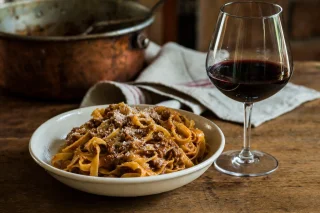
Grilled and roasted meats are the safe route, and Tuscan peposo alla fornacina is close to a local match. Wild boar ragu and aged pecorino both work with the tannin. Because Italian versions keep more acidity and less sweet fruit than an Australian Shiraz, they also handle lentils, mushrooms and roasted aubergine without overwhelming them.

Explore by style

Wine styles made from Syrah

Jump to the editorial guide for each style this grape turns up in.

Keep exploring

More red grapes

Sangiovese

Sangiovese (san-jo-vay-zeh) is the undisputed king of red wines in central Italy, virtually present in every area of the country Thanks to its many clones and surprising versatility, Sangiovese can create a wide range of wines: from young and fresh Chiantis to complex and full-bodied Brunellos.

Wines 382
Tannin
Body

Explore Sangiovese

Nebbiolo

Nebbiolo (Nay-bee-OH-lo) is a native Italian variety cultivated in the northern regions, whose name derives from the word “Nebbia” which is Italian for fog.

Wines 314
Tannin
Body

Explore Nebbiolo

Merlot

Merlot is a red grape with a serious Italian footprint: Bolgheri DOC, Bolgheri Rosso, Cortona DOC, Suvereto DOCG, Rubicone IGT and Montello Rosso DOCG form its Italian map.

Wines 164
Tannin
Body

Explore Merlot