






Wine route
Brunello and Rosso loop
Half a day to a full day · 4 stops
Open the driveYour cellar, your trips, and the wines you've been tracking are right where you left them.
New here?
Free, always. Education first, we'll never sell you anything you didn't ask to see.
Already have an account?
Enter the email you signed up with and we'll send a link to choose a new password.
Tuscany · DOCG
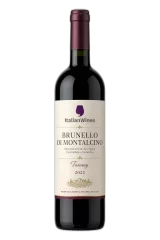
Brunello di Montalcino DOCG is Tuscany's long-aged Sangiovese, from the hills around Montalcino. It is built for structure, savoury cherry fruit and patient cellaring. Oak ageing and a late release give it a firm, polished frame. It belongs in the company of Barolo, Taurasi and Chianti Classico Riserva.
Decode the label
One word on the front changes the ageing, the strength and the price.
On the label
Brunello di Montalcino
the Annata, five years in the making
Sangiovese alone, two of its five years in oak: morello cherry, leather and tea, built to keep going.
In stock from £22.90 See the 175 bottles ↓On the label
Brunello Riserva
a sixth year before release
The same oak minimum with an extra year of patience: kept for the vintages a cellar believes in.
In stock from £25.60 See the 56 bottles ↓The boundary
Everything on this page, the estates, the bottles, the sub-zones, sits inside this line.
Wine route
Half a day to a full day · 4 stops
Open the drive
Estate 1
Montalcino · Southern slope
Tastings available
Estate 2
Montalcino · Castelnuovo dell'Abate
Tastings available
Estate 3
Montalcino
Tastings available
Estate 4
Montalcino
Tastings available
Estate 5
Montalcino
Tastings available
Estate 6
Montalcino
Book online
Estate 7
Montalcino
Tastings available
Estate 8
Castelnuovo dell'Abate
Tastings available
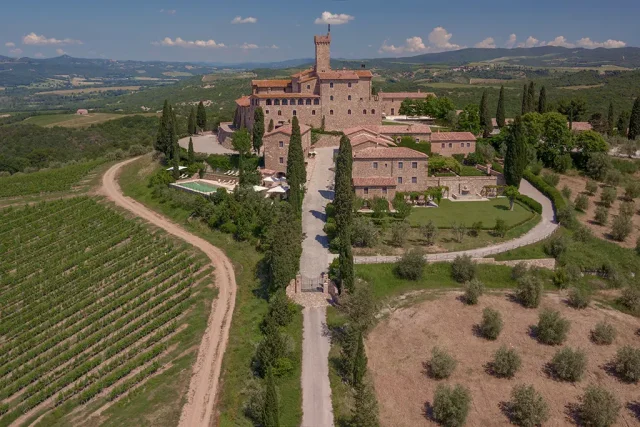
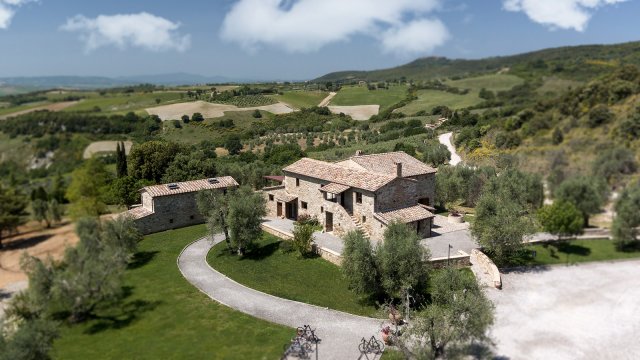
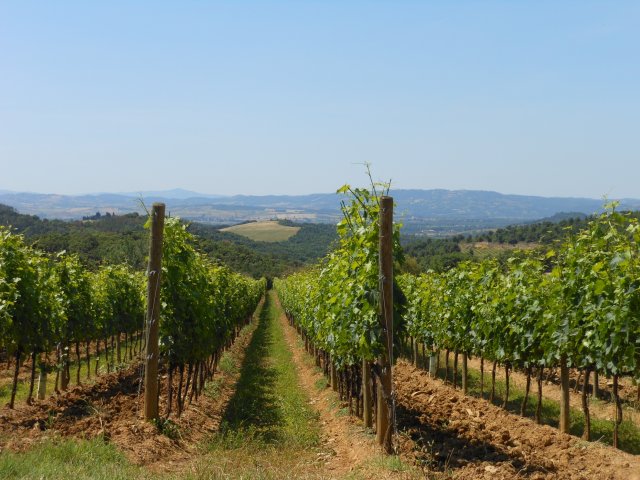
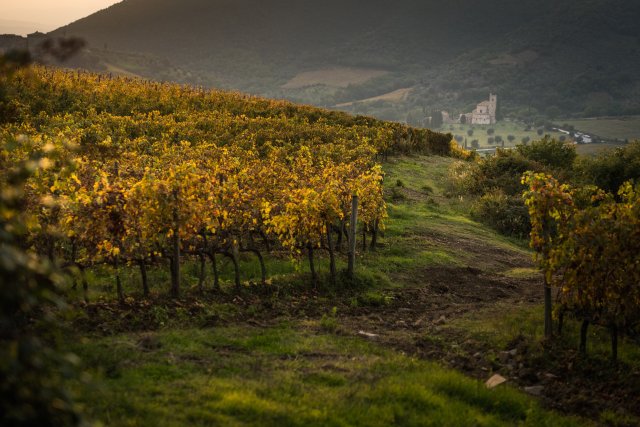
One commune, one hill: the zone is the territory of Montalcino alone, some forty kilometres south of Siena, ringed by the valleys of the Ombrone, Asso and Orcia. The hill climbs from river plain to woodland, so a single estate can pick weeks apart between its lowest and highest rows: the northern slopes run cooler and more perfumed, the southern side around Sant'Angelo riper and broader. That spread inside one boundary is why producer and position matter as much as the DOCG initials.
Inside the zone
Click or tap a pin for its estate. The numbered pins match the estate cards below.
Towns worth knowing
The hill town and its frazioni are the whole map; Sant'Antimo's abbey marks the south-east corner of the vineyards.
In the glass
Black cherry
Forest berries

Liquorice

Violet
The disciplinare
The same table on every denomination page, straight from the production rules.
 SangioveseAlone, by law: Montalcino's brown-tinged clone gave the wine its name100%
Solid means the rules demand it. Striped means optional, up to that amount. The words on the right say the same rule.
Two years in oak, of any size the rulebook fixes the time, not the barrel: botte grande and barrique both qualify.
No Brunello before 1 January of the fifth year counted from the harvest; Riserva waits until the sixth.
Bottling must happen in Montalcino vinification, ageing and bottling are all confined to the one commune.
A lesser year can step down the same wine may be declassified to Rosso di Montalcino by the cellar's own choice.
A vigna name carries obligations the named vineyard is registered, claimed at harvest, and enrichment is banned.
Ageing and alcohol minimums per tier are in the label guide above.
Editor's cellar
By style, today
Live prices, compared across 28 UK retailers.
Cellar doors · inside the zone
8 working estates with their gates open, numbered to match their pins on the map above.
No estates match these filters. Clear a filter to see more.
Experiences in the Brunello di Montalcino zone
Cellar experiences here average around €76. These are the strongest fits for this page.
Tenute Silvio Nardi
Private tour of the company with visit to the vineyards and aging cellars. Tasting of 6 wines: 2 vintages of Manachiara (Brunello Cru) 2 vin…
Tenute Silvio Nardi
Private tour of the company with visit to the vineyards and aging cellars. Tasting of 7 wines: -6 vintages of Brunello di Montalcino from th…
Tenute Silvio Nardi
Short tour of the vineyards followed by a visit to the cellars. Tasting of 4 wines, including 2 vintages of our Brunello di Montalcino
The years
Reading the years
Consorzio: annata eccezionale
The short version: Five stars for 2012, 2015, 2016, 2019 and 2020; 2014 is the one to pass over.
Tap a year for its note.
Brunello di Montalcino DOCG must come from Sangiovese grown inside the historic boundaries of the Montalcino town district. The rules allow no other grape, and in Montalcino the vine is called Brunello. The harvest is capped at 80 quintals per hectare, which is 8 tonnes of grapes. No more than 68 percent of that fruit may become wine. Put another way, 100 kilos of grapes may give at most 68 litres. The wine needs at least two years in oak and at least four months in bottle. A Riserva needs six months in bottle. The wine cannot be released before 1 January after five years from harvest, and a Riserva is held one further year. Minimum alcohol is 12.5 percent, and bottling must take place in the production area.
On the table
The home country leads; global pairings that genuinely work follow.
In-depth guide
Brunello di Montalcino is made from 100 percent Sangiovese. In Montalcino the grape is traditionally called Brunello. The DOCG allows no other grape in the wine.
Brunello di Montalcino cannot be released before 1 January after five years from harvest. It must spend at least two years in oak and at least four months in bottle. A Riserva waits one further year and needs six months in bottle.
No, they are two different wine names. Both use Sangiovese from Montalcino, but Rosso is released earlier and drinks younger. Brunello is aged longer, which gives it more structure and cellar life.
Brunello di Montalcino is dry, structured and tannic, with savoury Sangiovese fruit. Expect cherry and berry fruit, undergrowth, scented wood, a leather-like maturity and a firm finish once the wine has bottle age.
Serve Brunello di Montalcino at about 18 to 20 degrees Celsius. The Consorzio recommends large glasses. Very old bottles should be decanted gently, so that the wine shows clearly.
Yes, Brunello di Montalcino is built for long ageing. The growers' consortium notes that its ageing potential depends on the vintage. Many bottles improve for 10 to 30 years when they are stored correctly.
Explore more Tuscany
Same region only: the denominations Brunello di Montalcino drinkers reach for next.