






Wine route
Salento Negroamaro and Primitivo Trail
1 day · 5 stops
Open the driveYour cellar, your trips, and the wines you've been tracking are right where you left them.
New here?
Free, always. Education first, we'll never sell you anything you didn't ask to see.
Already have an account?
Enter the email you signed up with and we'll send a link to choose a new password.
Puglia · DOC
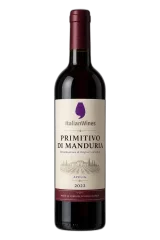
This is old-vine Primitivo, from Salento's red soils, ripened by the Ionian sun. Primitivo di Manduria DOC spans towns in southern Puglia such as Manduria, Sava and Avetrana. The rules require at least 85% Primitivo and 13.5% alcohol, rising to 14% on the Riserva. Expect deep ruby tilting to garnet, with black cherry, dried fig and sweet liquorice. The palate is velvety and full-bodied.
Decode the label
One word on the front changes the ageing, the strength and the price.
On the label
Primitivo di Manduria
the Salento's warm heart
Blackberry, prune and sweet spice at a strength the rules demand: 13.5% is the legal floor, not a style choice.
In stock from £12.54 See the 53 bottles ↓On the label
Primitivo di Manduria Riserva
two years, nine months of wood
The tier that shows Primitivo can age: fig and cocoa settle over the fruit after its two mandated years.
In stock from £13.95 See the 17 bottles ↓The boundary
Everything on this page, the estates, the bottles, the sub-zones, sits inside this line.
Wine route
1 day · 5 stops
Open the drive
Estate 1
San Marzano · Heart of the zone
Tastings available
Estate 2
Leporano · Ionian coast
Tastings available
The Ionian flank of the Salento peninsula, centred on Manduria and running through the neighbouring communes of Taranto and Brindisi provinces: flat, red-soiled country between the olive groves and the sea. The old alberello bush vines that survive here are the zone's treasure, planted low against the wind and heat, and the sea on two sides keeps the nights cooler than the latitude suggests.
Inside the zone
Click or tap a pin for its estate. The numbered pins match the estate cards below.
Towns worth knowing
Manduria gives the wine its name and its museum of Primitivo; the zone reaches into Brindisi province at its eastern edge.
In the glass
Black cherry
Plum

Violet

Blackberry

Black pepper
The disciplinare
The same table on every denomination page, straight from the production rules.
 PrimitivoThe early ripener; Zinfandel is the same grape abroadat least 85%Other local non-aromatic redsJointly cappedup to 15%
Solid means the rules demand it. Striped means optional, up to that amount. The words on the right say the same rule.
13.5% is the minimum, not the maximum the law demands ripeness most regions only permit.
Riserva means 24 months with 9 in wood counted from 1 November of the harvest.
9 tonnes per hectare, 70% to wine old bush vines rarely reach even that cap.
The sweet sibling is its own DOCG Primitivo di Manduria Dolce Naturale answers to a separate rulebook.
Primitivo means first to ripen the harvest here starts in August, among Italy's earliest.
Ageing and alcohol minimums per tier are in the label guide above.
Editor's cellar
By style, today
Live prices, compared across 18 UK retailers.
Cellar doors · inside the zone
Two estates inside the zone open their doors today. A small list, honestly kept: only working cellars with confirmed visits appear here.
No estates match these filters. Clear a filter to see more.
Vintage provenance
No denomination-wide vintage chart is currently published for Primitivo di Manduria DOC. The consorzio's annate page is empty, and English-language sources (Italian Wine Central, Wine Scholar Guild, Jancis Robinson) define the appellation but do not maintain a per-vintage rating table. Quality is tracked producer by producer rather than through a maintained annata.
Heat makes it reliable: buy the base wine young and give the Riserva three to six years.
What to check instead
The producer: quality here is tracked estate by estate rather than year by year.
Primitivo di Manduria DOC must be at least 85% Primitivo. Up to 15% of the blend can come from other black grapes. They must be non-aromatic varieties, grown in the Taranto and Brindisi provinces. Yields cap at 9 tonnes of grapes per hectare. The rules also permit sun-drying the grapes on the vine. That lifts ripeness and concentrates the sugars. The finished wine carries 13.5% alcohol as a minimum. On the Riserva that rises to 14%. Base bottlings can leave the cellar after 31 March following the harvest. Riserva demands 24 months of ageing in total, counted from 1 November of the vintage year. At least 9 of those months are in wood. That puts the earliest release on 1 November two years after the vintage, in the second autumn after the harvest.
On the table
The home country leads; global pairings that genuinely work follow.
In-depth guide
Primitivo di Manduria is a southern Italian red wine. It is made in eighteen communes across the Taranto and Brindisi provinces of Puglia. The DOC was created in 1974. It requires a minimum of 85% Primitivo, plus a maximum of 15% of other non-aromatic black varieties grown in the same area. A separate Primitivo di Manduria Dolce Naturale DOCG was carved out in 2011, for sweet versions made from dried grapes.
Inside the Salento peninsula at the southern tip of Puglia, between the Ionian coast and the inland hills. The rulebook lists Manduria, Sava, Avetrana, Lizzano, Maruggio, Fragagnano, San Marzano di San Giuseppe, Erchie, Oria and a dozen more, split between the Taranto and Brindisi provinces. Bush-trained alberello vines on red soil over limestone are the visual signature of the territory. They are planted dense, at 3,500 to 5,000 stocks per hectare.
Yes. DNA work has shown Primitivo to be genetically identical to California's Zinfandel, and to the Croatian Crljenak Kastelanski. Wines made under Primitivo di Manduria DOC still differ in style from Californian Zinfandel. Salento ripens hotter, the old bush vines limit yields, and the rules allow on-vine sun-drying. That lifts the black cherry, dried fig and liquorice notes Zinfandel rarely shows.
Deep ruby in youth, garnet with age. The aromas centre on steeped black cherry, plum, dried fig and bay leaf. Sweet liquorice and a sun-baked richness follow on the finish. The palate is full-bodied, ripe in tannin and velvety. It often carries 14 to 15% alcohol, thanks to Salento's long, hot summer. Riserva bottlings show more dried-fruit and tobacco character after their twenty-four months of ageing.
The DOC base is a dry red of minimum 13.5% alcohol, released after 31 March following the harvest. The DOCG Dolce Naturale is a sweet wine, made from grapes dried on the vine or on graticci. It reaches at least 16% natural alcohol, with 13% effective, and a minimum of 50 grams of sugar per litre. It is treated as a vino da meditazione. Serve it chilled with cantucci or aged caciocavallo, rather than alongside a meal.
Italian classics with body match the wine. Agnello al forno, lamb chops, cinghiale stews and beef braciole all hold the ripeness. Orecchiette al ragu di carne suits the lighter base release. Aged caciocavallo Podolico is the textbook cheese course. Light white fish and acid-led tomato dishes clash with the alcohol and ripe tannin.
The Riserva tier requires a minimum of 14% alcohol. It also requires 24 months of ageing from 1 November of the vintage year, including at least 9 months in wood. The earliest release is 1 November two years after the vintage, in the second autumn after the harvest. Riserva bottlings typically gain dried-fig and tobacco depth. They reward another five to ten years of cellar time before opening.
Explore more Puglia
Same region only: the denominations Primitivo di Manduria drinkers reach for next.