





Wine route
Strada del Prosecco
1 day · 8 stops
Open the driveYour cellar, your trips, and the wines you've been tracking are right where you left them.
New here?
Free, always. Education first, we'll never sell you anything you didn't ask to see.
Already have an account?
Enter the email you signed up with and we'll send a link to choose a new password.
Veneto · DOCG
Conegliano Valdobbiadene Prosecco DOCG is the hillside Prosecco Superiore. The fizz is Glera, from the steep hills of 15 towns north of Treviso in the Veneto. It sits above the flat-country Prosecco DOC, with a lower yield cap, hand-picked Rive wines and the small Cartizze slope. Most bottles are Brut or Extra Dry: pear, green apple and white blossom, best drunk young.
Decode the label
One denomination, 4 things it can say on the front. The qualifier is the whole story: every tier here is the same colour.
On the label
Spumante Superiore
the tank-method standard
A second fermentation in sealed steel tanks keeps pear and blossom fresh. The sweetness word on the label (Brut, Extra Dry, Dry) is a style, not a tier.
In stock from £11.04 See the 103 bottles ↓On the label
Rive
one village, picked by hand
Rive is dialect for steep slopes: grapes from a single named village or hamlet, hand-picked. The way to taste one hill against another.
In stock from £11.70 See the 14 bottles ↓On the label
Superiore di Cartizze
the one named slope
A single steep amphitheatre at San Pietro di Barbozza. Riper, rounder and usually a touch sweeter than the rest, with the top prices to match.
In stock from £20 See the 13 bottles ↓On the label
Sui lieviti
refermented in the bottle
The old farmhouse way, called col fondo locally: the yeast stays in the bottle, so it pours hazy with a bready edge and no sweetness.
In stock from £17 See the 2 bottles ↓The boundary
Everything on this page, the estates, the bottles, the sub-zones, sits inside this line.
Wine route
1 day · 8 stops
Open the drive
Estate 1
Santo Stefano di Valdobbiadene · Cartizze hills
Tastings available
Estate 2
Valdobbiadene · Foro Boario
Tastings available
Estate 3
Valdobbiadene · San Giovanni
Tastings available
Estate 4
Col S. Martino
Book online
Estate 5
Tarzo · Arfanta hills
Tastings available
Estate 6
Farra di Soligo · Soligo valley
Tastings available
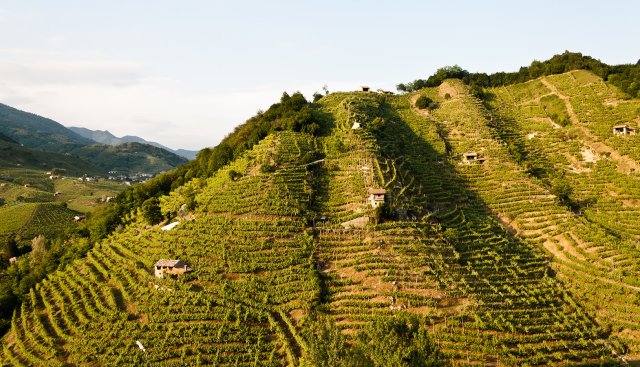
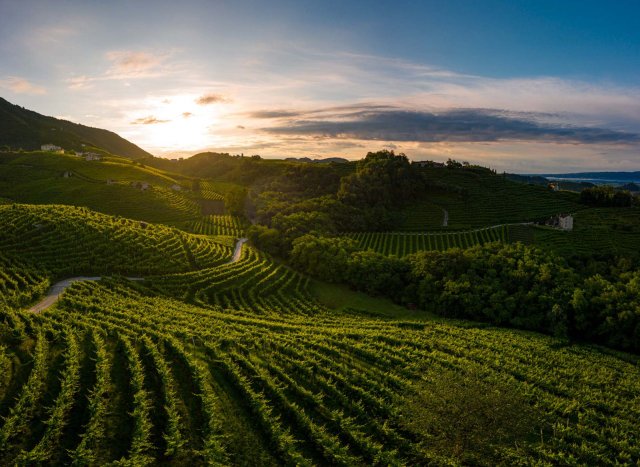
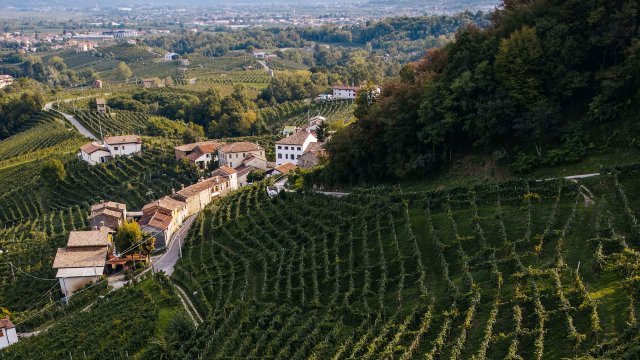
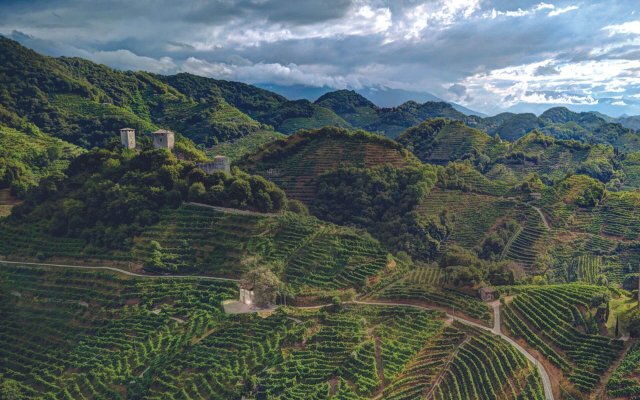
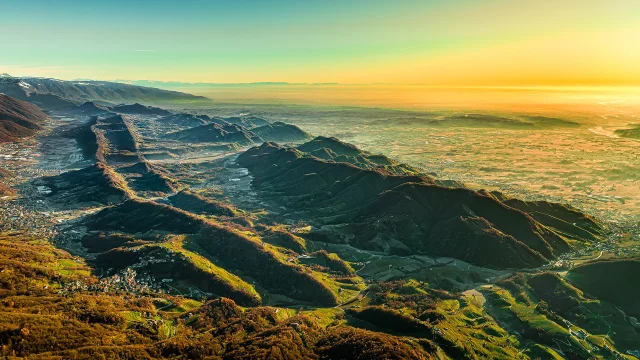
The zone is a band of steep ridges along the Treviso foothills. It runs east to west from Valdobbiadene, above the Piave river, to Vittorio Veneto, with Conegliano at the eastern end. The Prealps close the view to the north. Geologists call the shape hogback: sharp parallel crests of sandstone and clay with small valleys between them. Only the hillsides count. The valley floors and the plain to the south belong to the Prosecco DOC. At the western end, under the village of San Pietro di Barbozza, one bowl of slope is drawn separately as Cartizze, about 150 football pitches in all. UNESCO listed the hills in 2019 for the grassy terraces, the ciglioni, that hold the vines on slopes too steep for machines.
Inside the zone
Click or tap a pin for its estate. The numbered pins match the estate cards below.
Towns worth knowing
Valdobbiadene and Conegliano are the two poles that name the wine; San Pietro di Barbozza, Santo Stefano and Saccol are the Cartizze hamlets.
In the glass

Pear

Green Apple

Acacia

White peach

Lemon

Melon

Honey
The disciplinare
The same table on every denomination page, one row group per type here, because Conegliano Valdobbiadene Prosecco writes its rules per type.
 GleraThe grape, called Prosecco until 2009at least 85%
 Verdiso, Bianchetta Trevigiana, Perera, Glera LungaOld local companions, jointly cappedup to 15%Chardonnay, Pinot Bianco, Pinot Grigio, Pinot Nero (white-vinified)A traditional top-up inside the same 15% windowup to 15%GleraThe grapeat least 85%Verdiso, Bianchetta Trevigiana, Perera, Glera LungaStill allowedup to 15%Chardonnay and the PinotsNot allowed in the bottle-fermented version0%
Solid means the rules demand it. Striped means optional, up to that amount. The words on the right say the same rule.
Hills only, in 15 towns valley floors, north-facing slopes and the low plain are excluded by the rulebook.
13.5 tonnes a hectare at most against 18 for Prosecco DOC; a Rive drops to 13 and Cartizze to 12.
Rive means one village or hamlet 43 named places, grapes picked by hand, vintage on the label, released from 1 March.
Cartizze is about 150 football pitches the one slope with its own label name, made only inside Valdobbiadene, 11.5% minimum.
Prosecco may vanish from the label a spumante can be sold as plain Valdobbiadene DOCG or Conegliano DOCG; the place outranks the grape.
Ageing and alcohol minimums per tier are in the label guide above.
Editor's cellar
By style, today
Live prices, compared across 18 UK retailers.
Cellar doors · inside the zone
6 working estates with their gates open, numbered to match their pins on the map above.
No estates match these filters. Clear a filter to see more.
Experiences in the Conegliano Valdobbiadene Prosecco zone
Cellar experiences here average around €41. These are the strongest fits for this page.
Follador
Let us guide you to discover the fine perlage of our Valdobbiadene Prosecco Superiore D.O.C.G.: an ancient story, made of sacrifices and str…
Follador
We will tell you a story with deep roots, dating back over 2 centuries. We will retrace the steps of our ancestors, up to the present-day in…
Follador
A tribute to the Towers of Credazzo, a wonderful setting for our centuries-old history. A pleasure for the eyes, but also for the soul. You …
Sixteen names on the map
Cartizze is the one slope with its own name on the label. The other fifteen are the towns whose villages may follow the word Rive: 43 names in all.

The one slope with its own label name: 106 hectares of steep vines at San Pietro di Barbozza, Santo Stefano and Saccol. Hand-picked, the lowest yield cap, 11.5% minimum.
The western pole and the biggest Rive town. Six names: San Vito, Bigolino, San Giovanni, San Pietro di Barbozza, Santo Stefano and Guia, with Cartizze at its heart.
Two Rive on the Piave side of the hills, Vidor and Colbertaldo. The zone's southern boundary runs here along the old road to Ponte di Vidor.
Four Rive in the high valley under the Prealps: Miane, Combai, Campea and Premaor. Near Combai the boundary follows the 500 metre contour line.
Three Rive on the hill road from Soligo to Vidor: Farra di Soligo, Col San Martino and Soligo. The central stretch of the ridge.
Two Rive at the northern edge, Follina and Farrò. Here the Follina to Pieve di Soligo road meets the hill ridge at Tre Ponti.
Two Rive, Cison di Valmarino and Rolle, in the valley north of the main ridge. They sit close under the Prealpine wall that shelters the whole zone.
Two Rive at the centre of the zone, Pieve di Soligo and Solighetto. The boundary crosses the town along the old Ponte Priula road.
One Rive, Refrontolo itself, on the hills between Pieve di Soligo and Conegliano. The Refrontolo to Cozzuolo road marks part of the boundary.
Five Rive, second only to Valdobbiadene: San Pietro di Feletto, Rua, Santa Maria, San Michele and Bagnolo. The ridge runs between Conegliano and Refrontolo.
Four Rive on the northern hills: Tarzo, Resera, Arfanta and Corbanese. The boundary follows the Resera to Tarzo road on to Corbanese.
Three Rive on the southern hills above the Piave: Susegana, Colfosco and Collalto. The boundary turns west here along the road to Colfosco.
The eastern pole and home of Italy's first wine school, opened in 1876. Three Rive on the hills north of the town: Scomigo, Collalbrigo-Costa and Ogliano.
Four Rive at the eastern end of the hills: Formeniga, Cozzuolo, Carpesica and Manzana. The UNESCO site runs from Valdobbiadene to here.
One Rive, San Vendemiano itself, on the eastern edge just beyond Conegliano. Here the hills give way to the Treviso plain.
One Rive, Colle Umberto itself, in the north-eastern corner between Vittorio Veneto and Conegliano. The boundary drops here to the Alemagna road.
Vintage provenance
No denomination-wide vintage chart is published for Conegliano Valdobbiadene Prosecco. The consortium issues harvest reports and critics score single bottles, but nearly every bottle is a blend of years made to drink young. Only millesimato (at least 85% from one harvest), Rive and sui lieviti bottles must name a year; a Cartizze may or may not. The newest release is the one to buy.
Buy the newest release; only millesimato, Rive and sui lieviti bottles must name a year, a Cartizze may or may not, and even those are best within two or three.
What to check instead
The town: where a wine comes from inside the zone changes what is in the glass. See them above.
The producer: quality here is tracked estate by estate rather than year by year.
The grape is Glera, at least 85% of the blend. Up to 15% may come from the old local companions Verdiso, Bianchetta, Perera and Glera Lunga, or from Chardonnay and the Pinots. Only hillside vineyards qualify: valley floors, north-facing slopes and the low plain are out. Yields stop at 13.5 tonnes a hectare, 13 for a Rive and 12 for Cartizze. The fizz comes from a second fermentation in sealed steel tanks, the Martinotti method. The wine is bottled in the province of Treviso at 11% alcohol or more, in styles from Extra Brut to Demi-Sec. A Rive comes from one village, is picked by hand, carries its vintage and waits until 1 March. A Cartizze must be made inside Valdobbiadene and reach 11.5%. The sui lieviti version ferments again in the bottle, spends 90 days on its yeast and is sold cloudy and bone dry.
On the table
Venetian starters are its home ground: creamed salt cod, risi e bisi and polenta with shrimp, then pizza and focaccia; the bubbles scrub salt and oil off the palate.
In-depth guide
Prosecco Superiore is the DOCG from the hills of Conegliano and Valdobbiadene; Prosecco DOC covers nine mostly flat provinces. The hills cap yields at 13.5 tonnes a hectare against 18 on the plain, allow only hillside vineyards, and add the hand-picked Rive and Cartizze tiers. Same grape, stricter rules, usually a few pounds more.
Rive is the local word for steep slopes, and on a label it means the grapes come from one named village or hamlet. The rulebook lists 43 of them. A Rive must be picked by hand, state its vintage, keep to a lower crop of 13 tonnes and wait until 1 March after the harvest.
Cartizze is the one slope with its own name on the label: about 150 football pitches of very steep vines at San Pietro di Barbozza in Valdobbiadene. The label reads Valdobbiadene Superiore di Cartizze. The crop drops to 12 tonnes, alcohol must reach 11.5%, and most of it is made Dry, the softer style. In the UK it costs £20 to £41 a bottle.
Yes. Despite the name, Extra Dry carries more sugar than Brut: 12 to 17 grams a litre against under 12. It is the soft, off-dry style most Prosecco Superiore is sold as. Extra Brut is drier still, and Dry, at 17 to 32 grams, is the sweetest you will commonly see, often used for Cartizze.
No. It is made to drink within a year or two of release, when the pear and blossom are freshest. Only millesimato, Rive and sui lieviti bottles must name a year; a Cartizze may or may not. Even the dated ones rarely gain from waiting. Keep it cool and open it young.
Full bottles in stock on this page run from £11.04 for Luca Ricci's Brut to £41 for Nino Franco's Cartizze. Most Brut and Extra Dry bottles sit between £12 and £20. A Rive starts at £11.70 and a Cartizze at £20.
Because the rules allow it. On a sparkling wine the words Prosecco and Superiore may be left off, so a label can read Valdobbiadene DOCG, Conegliano DOCG or Conegliano Valdobbiadene DOCG. It is the same wine under the same rulebook, and the gold DOCG strip over the cork is the giveaway.
Explore more Veneto
Same region only: the denominations Conegliano Valdobbiadene Prosecco drinkers reach for next.