

























Chardonnay is a white grape with a clear Italian role.
Wines
623
Acidity
Body
White Grape · Piedmont
Moscato Bianco is the ancient Muscat behind Moscato d'Asti, Italy's featherweight sweet wine: intensely grapey and floral with orange blossom and peach, gently fizzy, and one of the few great wines you can enjoy at barely 5 percent alcohol.
Moscato is the white aromatic grape behind Moscato d'Asti DOCG and Asti Spumante DOCG in southern Piedmont. In Asti, Cuneo and Alessandria it gives low-alcohol, floral wines built on peach, orange blossom, sage and bright acidity. The styles run from gently fizzy to fully sparkling.
Your cellar, your trips, and the wines you've been tracking are right where you left them.
New here?
Free, always. Education first, we'll never sell you anything you didn't ask to see.
Already have an account?
Enter the email you signed up with and we'll send a link to choose a new password.
Setting it straight
The anchor fact: No. The cheap, mass-market wine sold around the world as 'Moscato' has little to do with Moscato d'Asti, a Piedmontese DOCG made from Moscato Bianco: an artisan, gently frizzante sweet wine, finished at barely 5 to 5.5 percent alcohol and made to be drunk young and fresh.
Taste · Where it sits
Forget scores out of five. Here’s Moscato described against grapes you already know.
About as light as wine gets: Moscato d'Asti is finished at just 5 to 6 percent alcohol, half the strength of most whites, so it feels weightless, cool and refreshing, a wine for brunch or the afternoon rather than the dinner table.
A white grape pressed off its skins, so there is effectively no tannin. The only 'grip' is the soft frizzante prickle and a lick of fresh acidity that stops the sweetness from turning flat.
Here is the twist: for a sweet wine, Moscato carries real acidity, and that freshness is exactly what keeps all the sugar from cloying, leaving it juicy and drinkable instead of syrupy.
Unashamedly sweet, and proud of it: ripe grape, peach and honey with obvious residual sugar, though the light Moscato d'Asti style stays gently sweet and lifted, while southern passito versions push towards full dessert-wine richness.
Key flavours




The map
Moscato is light to medium, crisp, fresh acidity, mapped against other white grapes you can buy. The closer a grape sits, the more its weight and freshness resemble Moscato.
Is this for you?
Reach for it when…
Maybe skip it if…
Serving guide
Serve at
6-8°C
Serve it properly cold, around 6 to 8C: the chill tightens the delicate fizz and keeps the fruit crisp, while a warm glass leaves the sweetness heavy and flat.
Decant
Not needed
Glass
Tulip Glass
Reach for a tulip glass: its tapered bowl gathers Moscato's orange-blossom and crushed-grape perfume, which is the whole point of the wine and exactly what a wide glass throws away.
Drink within
1-3 days
Once open, finish it within a couple of days: the soft frizzante prickle and fresh-grape scent fade fast, so this is not a bottle to leave half-full for a week.
Cellar
1-2 years
Buy the youngest vintage you can and drink it inside a year or two: Moscato d'Asti is bottled to capture one harvest's fresh, grapey fruit, and it only tires with age, never improves.
On the table
Start with the home-table matches that made the grape, then browse the full cuisine library.

Orange blossom, twice
Naples' ricotta-and-wheat Easter tart is scented with orange-blossom water, the exact floral note that defines Moscato, so the wine doubles the pastry's perfume while its low-alcohol sweetness matches the candied-citrus richness.

Sardinia's honey match
Sardinia's fried pecorino pastries drizzled with bitter honey meet their regional partner in Moscato di Sardegna: the wine's grapey sweetness flatters the warm cheese while its fresh acidity cuts the honey before it cloys.

Sweet against salty blue
The oldest trick with a salty blue is a sweet wine, and Moscato's honeyed, low-alcohol sweetness tames Stilton's punchy, mineral tang the way a drizzle of honey does, with the gentle fizz scrubbing the creamy paste clean.

A cool foil for the heat
A spiced, creamy curry wants sweetness and a little fizz: Moscato's grape-and-peach sugar cools the chilli warmth in butter chicken where a dry wine would stoke it, and at 5 percent alcohol it will not add fuel to the fire.
Browse every pairing
Buy it · three to start with
A curated trio across the price range, then every Moscato on sale in the UK right now.
Entry · everyday
 1 retailer
Asti
1 retailer
£8.79
£11.34
Why this one: Cantine Bosca is a long-established house in the Asti zone, and this is Moscato d'Asti at its most everyday: gently frizzante, all fresh grape and peach, and light enough at around 5 percent to open before lunch. The honest, inexpensive way to meet the grape.
The sweet spot
 2 retailers
Asti
2 retailers
£14.00
Why this one: In 1978 the Rivetti family's La Spinetta bottled the first ever single-vineyard Moscato d'Asti, and Bricco Quaglia remains the benchmark: a named cru from Castagnole delle Lanze, more perfumed and precise than everyday Moscato, and the bottle that proved this 'simple' sweet wine could be taken seriously.
12 of 59 bottles
 6 retailers
Terre Siciliane
6 retailers
£19.50
 5 retailers
Asti
5 retailers
£13.50
 4 retailers
Asti
4 retailers
£12.35
 4 retailers
Asti
4 retailers
£14.00
 4 retailers
Asti
4 retailers
£14.40
£16.00
 3 retailers
Asti
3 retailers
£9.21
 2 retailers
Asti
2 retailers
£8.54
 2 retailers
Asti
2 retailers
£8.93
£11.90
 2 retailers
Asti
2 retailers
£9.80
 2 retailers
Asti
2 retailers
£10.60
 2 retailers
Asti
2 retailers
£12.00
 2 retailers
Asti
2 retailers
£12.72
Denominations
The appellations where Moscato plays a starring role.
Where it grows

From Barolo's tannic spine to Asti's gentle fizz, Piedmont turns Nebbiolo, Barbera, Moscato, and Cortese into Italy's most cru-mapped wine country. Read more

From galestro hills in Chianti Classico to the single Brunello rise of Montalcino and the sea-facing Cabernets of Bolgheri, Tuscany is Italian wine's stage in Read more

From Franciacorta classic-method bubbles to Valtellina mountain Nebbiolo and Lugana lake-cool whites, Lombardy spans 5 DOCGs across roughly 25,000 hectares of Read more

Granite-soil Vermentino in Gallura, schist-grown Cannonau in Ogliastra and bush-vine Carignano on the Sulcis sands: Sardinia bottles a Mediterranean profile Read more

From Manduria's Primitivo bottlings to Salento's Negroamaro estates and Castel del Monte's Nero di Troia DOCG hills, Puglia offers Italy's deepest catalogue Read more

Italy's largest wine region by volume, where Prosecco hills, Valpolicella ridges, and Soave's volcanic plain shape three different Italian classics. Read more
The terroir
The same grape shifts character dramatically with latitude. In the cool Piedmont hills it makes the lightest, fizziest, lowest-alcohol sweet wine in Italy; travel south and the sun turns it richer, riper and, in places, almost fortified.
Asti and Canelli
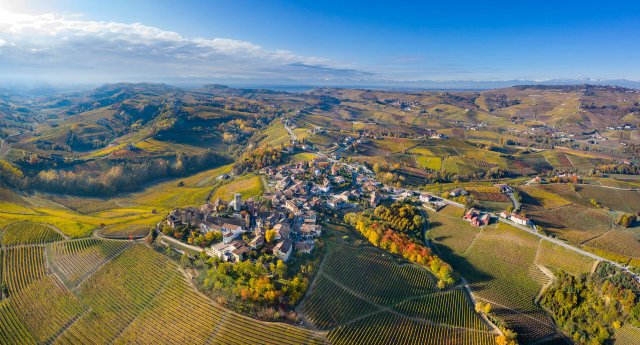
The hills of the Langhe and Monferrato in Piedmont, gathered around the town of Canelli
Moscato's heartland: gently fizzy, barely 5 percent Moscato d'Asti and the fuller, fully sparkling Asti Spumante, both DOCG. The same hills also make its sweet red cousin, Brachetto d'Acqui.
Moscadello di Montalcino
The Montalcino hills of Tuscany, long before Brunello made them famous
A historic, delicately sweet Moscato Bianco that was once Montalcino's signature wine, now a rare artisan revival in still, frizzante and passito forms.
Moscato di Trani
The sun-baked Adriatic plains of Apulia, in the deep south-east
A richer, riper face of the grape, known here as Moscato Reale: warm-climate Moscato Bianco made into a golden, honeyed dessert wine, including fortified liquoroso versions a world away from the featherweight north.
Producers
11 estates on the site work with Moscato. Eight at a time, and the line-up changes every week.
Editorial
Moscato on this site means Moscato Bianco. That is the Italian name for Muscat Blanc à Petits Grains, one of the oldest cultivated vines in the Mediterranean. Latin writers recorded aromatic Muscat grapes pressed for sweet ceremonial wine. Medieval monasteries then carried the variety across southern Europe. Its small golden berries are loaded with terpenes. That is why the wines smell so obviously of the grape itself.
The secret to Moscato d'Asti is a fermentation left unfinished. Winemakers chill the fermenting must to a near-stop before the yeast can eat all the sugar, capturing natural sweetness, a soft prickle of trapped carbon dioxide and an alcohol level of barely 5 percent, all from one single fermentation, where Prosecco and Champagne need a second one just to get their bubbles.
The arrested-fermentation method of Moscato d'Asti, PiedmontPiedmont is the heartland. The Asti DOCG zone spans 51 communes across Asti, Alessandria and Cuneo. It is centred on the Moscato hills around Canelli and Santo Stefano Belbo, and it feeds both Moscato d'Asti DOCG and Asti Spumante DOCG. The two wines part company in the cellar, not the vineyard. Moscato d'Asti is made by the partial-fermentation Asti method. The wine is chilled to halt fermentation early, so it stays gently frizzante and rarely climbs above 5.5% alcohol. Asti Spumante uses the tank, or Martinotti, method for a fully sparkling wine at roughly 7 to 9.5%. Both keep the grape's natural sugar and low alcohol rather than chasing weight.
Moscato Bianco is unusually versatile. It appears as still wine, as sparkling and as passito. Piedmont alone uses it in smaller denominations such as Loazzolo DOC and Strevi DOC. Beyond the region it reaches Moscadello di Montalcino in Tuscany, Moscato di Trani in Apulia and Moscato di Sardegna. It also reaches the Sicilian sweet wines of Siracusa and Noto. Do not confuse it with its aromatic relatives. Zibibbo, or Moscato di Alessandria, is the distinct grape behind Pantelleria's passito. Moscato Giallo, Moscato Rosa and the red Moscato di Scanzo DOCG in Lombardy are separate varieties in the same fragrant family.
Good to know
Moscato is the grape. Moscato d'Asti DOCG is a Piedmont wine made from Moscato Bianco. Asti Spumante DOCG also uses the same grape.
Most familiar Italian Moscato wines are sweet or gently sweet. That is true above all of Moscato d'Asti DOCG and Asti Spumante DOCG. Dry aromatic versions exist, but they are not what most UK searches are after.
Moscato d'Asti suits fruit-led desserts, panettone, panna cotta, hazelnut cake and soft blue cheese. Its acidity and bubbles keep the sweetness from feeling heavy.
Yes. Serve Moscato d'Asti and Asti Spumante well chilled, usually around 6-8 C. The chill keeps the aromas lifted and the sweetness balanced.
Moscato usually tastes of peach, apricot, orange blossom, sage, honey and fresh grape. The best Piedmont versions are aromatic, sweet, low in alcohol and bright with acidity.
Explore by style
Jump to the editorial guide for each style this grape turns up in.
Keep exploring