About La Crotta di Vegneron
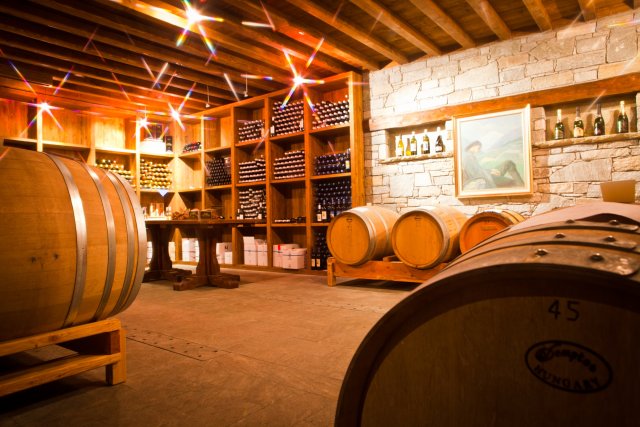
The cooperative was founded in 1980 by twenty-five Chambave growers. They pooled their grapes and a single cellar so the village's farming families could keep bottling under their own name. Today fifty-three families carry on that founding agreement. The name comes from the Franco-Provençal of the Aosta Valley. A 'crotta' is the cellar carved from rock that every village hamlet has. 'Vegneron' is the local form of the French 'vigneron', a winegrower.
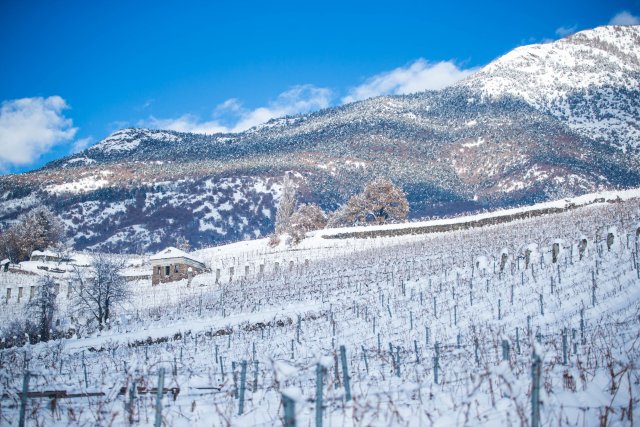
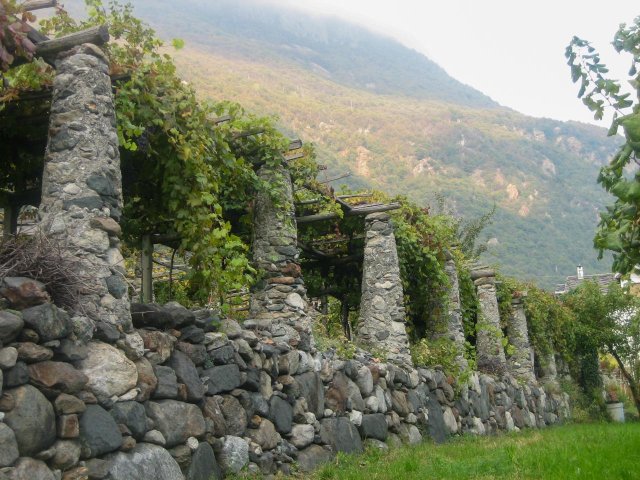
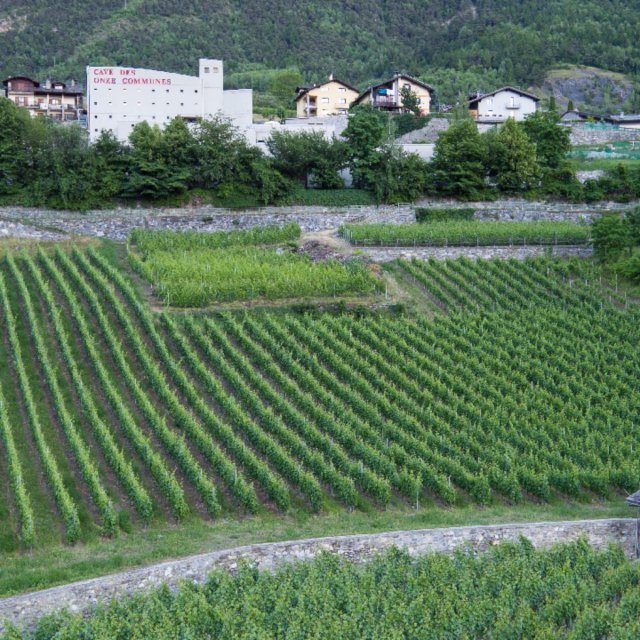
The fruit comes from two central-valley zones of the Valle d'Aosta DOC. The first is Chambave, which also takes in Châtillon, Saint-Vincent, Saint-Denis and Verrayes. The second is Nus, with Quart and Fénis. The members hand-farm roughly 21 hectares of terraced parcels, on slopes of 20 to 35 percent. Everything grows between 500 and 850 metres. Output sits at 180,000 to 200,000 bottles a year. It splits across fifteen still Valle d'Aosta DOC labels and the Quatremillemètres line of mountain sparklers.
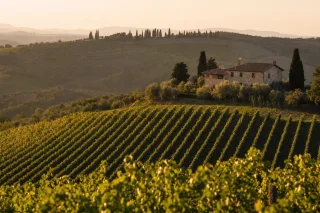
This is alpine winegrowing in its most demanding form. Ninety percent of the parcels face south. Rainfall is low, and daytime sun beats onto schist and sandy glacial soils. At night, sharp cooling flows off the 4,000-metre peaks around the valley. The grapes ripen slowly, holding aromatic precision and bright acidity. The winemaking deliberately preserves that character rather than dressing it up.
The flagship is Moscato di Chambave, the white Muscat that has carried Chambave's reputation for centuries. The dry version is precise and floral. The flétri version, called passito in Italian, is dried on racks before pressing. It is one of the Aosta Valley's most distinctive sweet wines. Nus Malvoisie comes from Pinot Gris, which locals call Malvoisie. The reds rest on Aostan natives. Petit Rouge goes into the Chambave Rouge and Torrette blends. Fumin makes the serious, dark-fruited reds. Cornalin and Vien de Nus give lighter alpine reds, and Petite Arvine holds the white side. Müller-Thurgau, Gamay and Pinot Noir round out the range.
Two small-volume projects sit outside the conventional cellar. The Quatremillemètres line is a brace of metodo classico sparklers, named for the high peaks that ring the valley. The Vins des Mines selection is finished and aged inside the disused tunnels of the Costa del Pino mine at Cogne. Steady cold, humidity and total darkness slow the ageing there in a way no above-ground cellar can match. La Crotta also distils a small range of single-grape grappa from its own pomace.
Editorial · ItalianWines.co.uk













 Aosta Valley
 4 wines
  Tastings
 Tours
Tours
 Booking required



 Moscato Bianco
 Fumin
Fumin