






Wine route
Brunello and Rosso loop
Half a day to a full day · 4 stops
Open the driveYour cellar, your trips, and the wines you've been tracking are right where you left them.
New here?
Free, always. Education first, we'll never sell you anything you didn't ask to see.
Already have an account?
Enter the email you signed up with and we'll send a link to choose a new password.
Tuscany · DOC
Rosso di Montalcino is Brunello's younger sibling: 100% Sangiovese from the same Tuscan hill, sold from the September after the harvest rather than five years on. It keeps the cherry fruit and the grip of Montalcino with a fraction of the wait. It comes from the same estates and the same slopes, at everyday prices.
Decode the label
One word on the front changes the ageing, the strength and the price.
On the label
Rosso di Montalcino DOC
the whole label
One legal tier, no Superiore, no Riserva: the producer and the vineyard do the sorting. Most of the shelf sits between £15 and £30.
In stock from £15.33
The boundary
Everything on this page, the estates, the bottles, the sub-zones, sits inside this line.
Wine route
Half a day to a full day · 4 stops
Open the drive
Estate 1
Montalcino · Poggio alle Mura
Tastings available
Estate 2
Montalcino · Le Chiuse
Tastings available
Estate 3
Montalcino · Camigliano
Tastings available
Estate 4
Montalcino · Castelnuovo dell'Abate
Tastings available
Estate 5
Montalcino · Mocali
Tastings available
Estate 6
Montalcino · Mercatali
Tastings available
Estate 7
Montalcino · Castello di Argiano
Tastings available
Estate 8
Castelnuovo dell'Abate · Podere Palazzo
Tastings available
Estate 9
Montalcino · Casale del Bosco
Book online
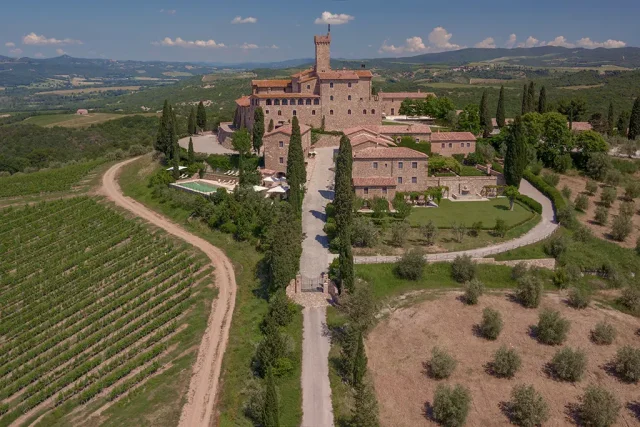
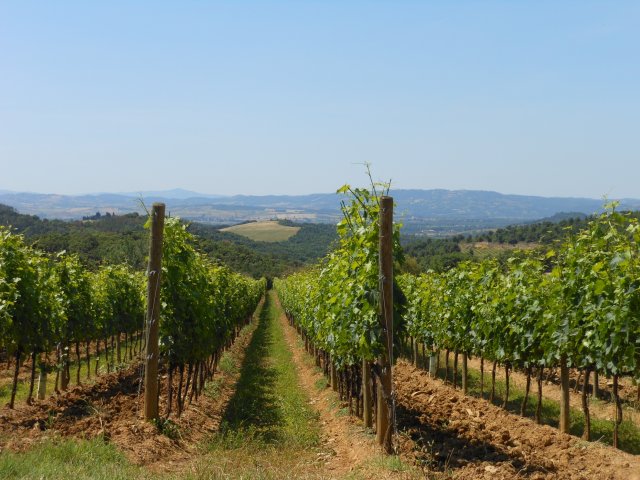
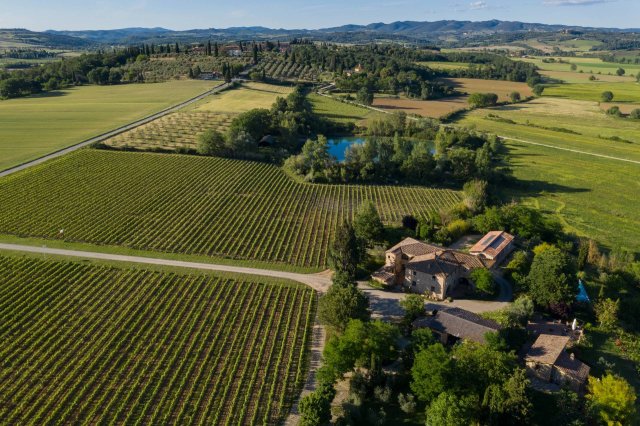
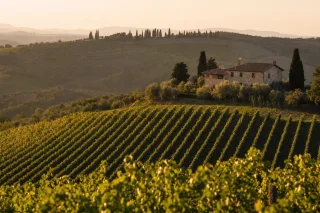
One commune, one hill. The zone is the territory of Montalcino, some 40 km south of Siena. It is an almost square block about 15 km across, walled in by the valleys of the Orcia, the Asso and the Ombrone. The land rises from about 120 metres by the rivers to about 650 metres at Poggio Civitella, the summit. The sea is 40 km to the west and the Apennines 100 km to the east. The hill is dry and windy, and the middle slopes escape fog and late frost. There are no sub-zones; the estate name and its side of the hill are the map.
Inside the zone
Click or tap a pin for its estate. The numbered pins match the estate cards below.
Towns worth knowing
The hill town and its hamlets are the whole map; Castelnuovo dell'Abate, beside the abbey of Sant'Antimo, and Sant'Angelo in Colle hold the southern half.
In the glass
Black cherry
Forest berries

Violet

Liquorice
The disciplinare
The same table on every denomination page, straight from the production rules.
 SangioveseThe only grape allowed; called Brunello on the hill100%
Solid means the rules demand it. Striped means optional, up to that amount. The words on the right say the same rule.
No ageing rule, just a date nothing sells before 1 September of the year after harvest.
Yields are capped at 9 tonnes per hectare 8 for a vigna wine, and new vineyards need 4,000 vines a hectare.
Made, stored and bottled inside the commune in a dark Bordeaux bottle, and every batch passes a tasting panel.
Superiore and Riserva are banned words so are Selezione, Tradizionale and Vecchio; the vintage must always appear.
A Brunello can step down to Rosso the estate may declassify wine still in the cellar and keep its vigna name.
Ageing and alcohol minimums per tier are in the label guide above.
Editor's cellar
By style, today
Live prices, compared across 26 UK retailers.
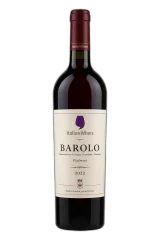
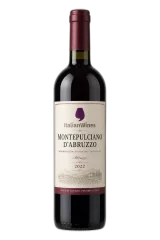
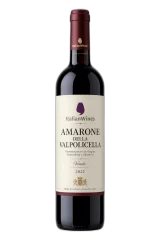
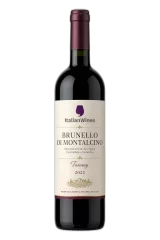
 5 retailers
Rosso di Montalcino
5 retailers
£19.50
 5 retailers
Rosso di Montalcino
5 retailers
£70.90
£77.91
Cellar doors · inside the zone
9 working estates with their gates open, numbered to match their pins on the map above.
No estates match these filters. Clear a filter to see more.
Experiences in the Rosso di Montalcino zone
Cellar experiences here average around €69. These are the strongest fits for this page.
Tenute Silvio Nardi
Private tour of the company with visit to the vineyards and aging cellars. Tasting of 6 wines: 2 vintages of Manachiara (Brunello Cru) 2 vin…
Tenute Silvio Nardi
Private tour of the company with visit to the vineyards and aging cellars. Tasting of 7 wines: -6 vintages of Brunello di Montalcino from th…
Tenute Silvio Nardi
Short tour of the vineyards followed by a visit to the cellars. Tasting of 4 wines, including 2 vintages of our Brunello di Montalcino
The years
Chart ratings come from the Consorzio del Vino Brunello di Montalcino's yearly star evaluation, which classifies Rosso di Montalcino by name alongside Brunello. Our chart runs to 2020, the last year with stars on the consortium's tiles. Rosso is released after about a year with no oak requirement. A year rated for long ageing may simply give a bigger Rosso, and a lighter year a fresher one.
Reading the years
Five stars, outstanding on the consortium's chart
The short version: Five stars for 2015, 2016, 2019 and 2020 on the consortium's chart; buy the newest good year and drink it young.
Tap a year for its note.
The rules fit on a page. The grape is Sangiovese and nothing else, grown anywhere inside the municipality of Montalcino, in the province of Siena. Yields are capped at 9 tonnes a hectare, or 8 for a wine that names its vineyard, and new vineyards must carry at least 4,000 vines a hectare. There is no ageing rule at all. Instead the law sets a date: no bottle may be sold before the 1st of September of the year after the harvest. The wine must reach 12% alcohol, pass a tasting panel, and be made, stored and bottled inside the municipality, in a dark Bordeaux bottle. Words such as Superiore, Riserva, Selezione and Tradizionale are banned from the label. A Brunello still in the cellar may be stepped down to Rosso if the estate prefers to sell it young.
On the table
Lasagne, schiacciata and pasta with a meat or mushroom sauce: Sangiovese's acidity and grip cut the fat and meet tomato head on.
In-depth guide
Time. Both are 100% Sangiovese from the municipality of Montalcino. Brunello must spend two years in oak and cannot be sold before 1 January of the fifth year after the harvest. Rosso has no ageing rule and can be sold from 1 September of the following year. The Rosso is lighter, fresher and far cheaper.
A DOC, since 25 November 1983. Brunello di Montalcino, from the same municipality and the same grape, is the DOCG. Both are looked after by the same producers' consortium in Montalcino.
Sangiovese, and nothing else. The rules allow no other grape. On the hill the grape is called Brunello.
Bright ruby, with fresh cherry and red-berry fruit, a warm middle and a gentle tannic grip. The rulebook itself calls it dry, warm and a little tannic; the producers' consortium calls it lively and fresh, made to drink young. It is medium to full in body.
Follow the consortium's chart: 2015, 2016, 2019 and 2020 were five-star years, 2017 and 2018 four. Our chart runs to 2020, the last year with stars on the consortium's tiles. Rosso is sold within a year of the harvest, so buy the newest good year and drink it young.
Pasta with a meat, poultry, mushroom or truffle sauce, and pork or veal: that is the producers' consortium's list. The rulebook adds salumi, cheeses and lighter meats. On this page the Tuscan table shows a lasagne and schiacciata, the Tuscan flatbread.
Most bottles sit between £15 and £30. Il Poggione, Argiano, Col d'Orcia and Banfi start around £18 to £21; the famous names, Biondi-Santi, Salvioni and Poggio di Sotto, charge £55 to £75. The price table on this page tracks live UK shop prices.
From the 1st of September of the year after the harvest, so a 2024 Rosso can be on sale from September 2025. There is no minimum ageing; the date is the only rule.
Explore more Tuscany
Same region only: the denominations Rosso di Montalcino drinkers reach for next.