






Wine route
Strada del Vino Costa degli Etruschi
1-2 days · 4 stops
Open the driveYour cellar, your trips, and the wines you've been tracking are right where you left them.
New here?
Free, always. Education first, we'll never sell you anything you didn't ask to see.
Already have an account?
Enter the email you signed up with and we'll send a link to choose a new password.
Tuscany · DOC
Val di Cornia is the iron valley behind the Etruscan Coast. It runs inland from Piombino through Suvereto and Campiglia Marittima. This was mining country long before it was vineyard country. The Sangiovese-led reds won their own DOCG in 2011. The DOC still covers the valley's whites and rosato.
Decode the label
One word on the front changes the ageing, the strength and the price.
On the label
Rosso DOCG
Sangiovese in charge
The valley's summit tier since the 2011 harvest.
No bottles in stock right now
On the label
Rosso Riserva
Wood, bottle and patience
Held until the third New Year after harvest.
No bottles in stock right now
On the label
DOC bianco and rosato
The valley's fresh side
Drink within two summers, ideally at Baratti.
No bottles in stock right now
The boundary
Everything on this page, the estates, the bottles, the sub-zones, sits inside this line.
Wine route
1-2 days · 4 stops
Open the drive
Estate 1
Suvereto
Book online
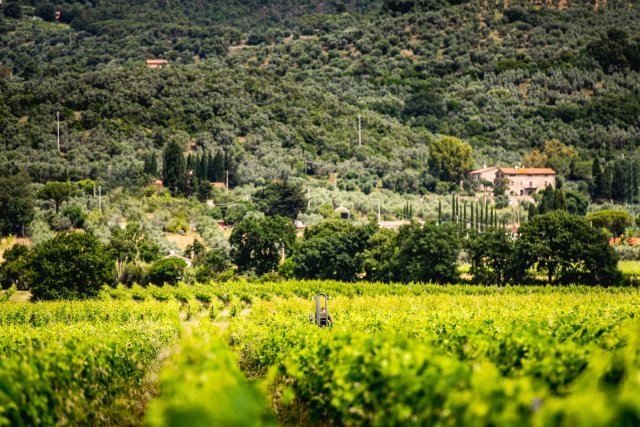
The zone follows the Cornia river from the Colline Metallifere down to the sea at Piombino: Suvereto and Sassetta entire, plus the vine-bearing parts of Campiglia Marittima, San Vincenzo and Piombino. Iron-streaked soils, hot summers tempered by the Tyrrhenian, and the Etruscan mining park at the valley mouth explain both the wine's colour and its name recognition.
Inside the zone
Click or tap a pin for its estate. The numbered pins match the estate cards below.
Towns worth knowing
Suvereto's walls and Campiglia's terraces hold most of the cellars; San Vincenzo is the shore.
In the glass
One profile at a time, never blended into a single set of bars.
Black cherry
Plum
Tobacco
Lemon

Green Apple
The disciplinare
The same table on every denomination page, straight from the production rules.
Solid means the rules demand it. Striped means optional, up to that amount. The words on the right say the same rule.
Sangiovese stays in charge at least 40 percent of the DOCG rosso, the valley's answer to Suvereto's Bordeaux lead.
Two dates to remember rosso sells from the 1st of May of year two; the Riserva from the New Year after, with 18 months' wood behind it.
Twin promotions Val di Cornia Rosso and Suvereto rose to DOCG together in 2011, both carved from the 1989 DOC.
No Aleatico in the blend the sweet grape is fenced out of the rosso by name.
Ageing and alcohol minimums per tier are in the label guide above.
Cellar doors · inside the zone
One estate inside the zone opens its doors today. A small list, honestly kept: only working cellars with confirmed visits appear here.
No estates match these filters. Clear a filter to see more.
Experiences in the Val di Cornia zone
Cellar experiences here average around €68. These are the strongest fits for this page.
Azienda Agricola Tua Rita
A wine experience in pure Tua Rita's style, a walk in the vineyards, a visit to the winery, and to conclude a tasting of 4 Tuscan wines
Azienda Agricola Tua Rita
A unique experience immersed in the scents of French oak barrels, where you can experience the emotion of tasting wines from the barrel
Vintage provenance
No denomination-wide vintage chart is published for Val di Cornia; quality is tracked producer by producer.
What to check instead
The producer: quality here is tracked estate by estate rather than year by year.
The Rosso was raised to DOCG from the 2011 harvest. Sangiovese must make up at least 40 percent of the blend. Cabernet Sauvignon and Merlot can fill up to 60 percent between them. Other red grapes are capped at 20 percent, and Aleatico is shut out. The wine must reach 12.5 percent alcohol, or 13 percent for the Riserva. It cannot be sold before the 1st of May of the second year. The Riserva waits longer, until the New Year after that. By then it has spent at least 18 months in wood and six in bottle. The wider Val di Cornia DOC covers the bianco, mostly Vermentino and Trebbiano. It also covers the rosato, made from the same red grapes.
On the table
The home country leads; global pairings that genuinely work follow.
In-depth guide
They are twin DOCGs, promoted together in 2011 from the same 1989 DOC. Val di Cornia Rosso keeps Sangiovese in charge, at 40 percent minimum. Suvereto lets Cabernet and Merlot lead. The wider Val di Cornia DOC still covers the whites and rosato.
Dark cherry and plum over an iron edge, which comes from the Colline Metallifere soils. It is firmer than Bolgheri's polish. The minimum alcohol is 12.5 percent, and the Riserva adds 18 months of wood.
Suvereto and Sassetta sit inside the zone entirely. Parts of Campiglia Marittima, San Vincenzo and Piombino are in as well. All of them are in Livorno province, behind the Etruscan Coast.
Explore more Tuscany
Same region only: the denominations Val di Cornia drinkers reach for next.



 15
15


