






Wine route
Strada dei Vini di Romagna
2 days, 110 km · 7 stops
Open the driveYour cellar, your trips, and the wines you've been tracking are right where you left them.
New here?
Free, always. Education first, we'll never sell you anything you didn't ask to see.
Already have an account?
Enter the email you signed up with and we'll send a link to choose a new password.
Emilia Romagna · DOCG
Italy's first white DOCG is a Romagna hill wine that comes dry, sweet or made from dried grapes. Romagna Albana must be at least 95% Albana, grown on the first hills above the Via Emilia. The zone's heart runs from Imola to Cesena. The dry Secco is warm, faintly tannic and tastes of apricot and almond. The Passito is a golden dessert wine from grapes dried until spring.
Decode the label
One denomination, 5 things it can say on the front. Colour first, then the qualifier.
On the label
Romagna Albana Secco
the dry one
Dry, warm and faintly tannic for a white: apricot and almond with a grip you do not expect.
In stock from £12.10 See the 2 bottles ↓On the label
Romagna Albana Dolce
sweet from ripe grapes
The old festival wine: fruit and sugar left in, with the acidity Albana keeps even when ripe.
In stock from £12.90 See the 1 bottle ↓On the label
Romagna Albana Amabile
the gentle middle
A touch of sweetness on the same fruit, rarely seen on UK shelves.
No bottles in stock right now
On the label
Romagna Albana Passito
the golden dessert wine
Grapes dried until as late as 30 March and pressed at 284 grams of sugar a litre: apricot, quince and honey.
In stock from £15.50 See the 1 bottle ↓On the label
Romagna Albana Passito Riserva
the noble-rot one
From grapes touched by noble rot, shrivelled on the vine or dried after picking: the richest of the five.
No bottles in stock right now
The boundary
Everything on this page, the estates, the bottles, the sub-zones, sits inside this line.
Wine route
2 days, 110 km · 7 stops
Open the drive
Estate 1
Imola
Tastings available
 Albana
Estate 2
Forlì
Tastings available
Albana
Estate 3
Marzeno
Tastings available
Albana
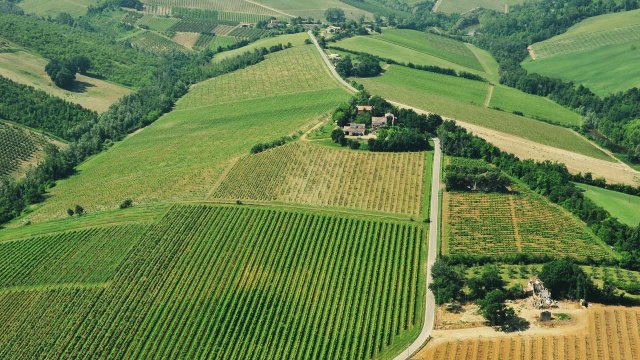
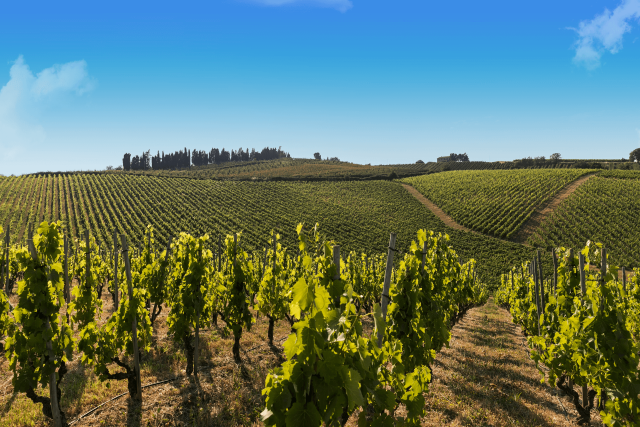
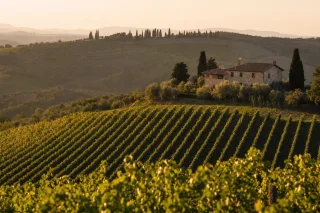
A strip of first hills above the Via Emilia. It starts at Ozzano Emilia and Castel San Pietro Terme, west of Imola, and runs through Faenza and Forli to Bertinoro, Cesena and Savignano sul Rubicone. The lower edge is the road itself and the Rimini to Bologna railway, so the flat land towards the coast is out. The heart of the zone is the Spungone, a yellow ridge of fossil-rich sandy limestone from the Faenza hills to Cesena. It is the first rise you see from the road. Its south faces are steep and sunny, and the best Albana grows above 100 metres on the clay, limestone and yellow sand on either side of it. The castles of Bertinoro, Meldola and Castrocaro stand on the same rock.
Inside the zone
Click or tap a pin for its estate. The numbered pins match the estate cards below.
Towns worth knowing
Bertinoro is the cradle; the zone runs along the first hills above the Via Emilia from Ozzano Emilia, west of Imola, to Savignano sul Rubicone, east of Cesena.
In the glass
One profile at a time, never blended into a single set of bars.

Apricot
Almond

Peach

Acacia
Apricot
Peach
Acacia
Apricot

Honey
Raisin

Spicy
The disciplinare
The same table on every denomination page, straight from the production rules.
 AlbanaThe whole story, near enoughat least 95%Other white grapes of Emilia-RomagnaA pinch, rarely usedup to 5%
Solid means the rules demand it. Striped means optional, up to that amount. The words on the right say the same rule.
One of five words must be on the label Secco, Amabile, Dolce, Passito or Passito Riserva; extra, superiore and fine are banned.
Italy's first white DOCG promoted in 1987 after twenty years as a DOC, and renamed Romagna Albana in 2011.
Passito grapes may dry until 30 March and must hold 284 grams of sugar a litre before pressing; on sale from 1 September the year after.
10 tonnes a hectare and 100 kilos of grapes may give 70 litres of wine, or 50 litres for Passito.
The vintage must be printed on every bottle, and wood is allowed for every type.
Ageing and alcohol minimums per tier are in the label guide above.
Editor's cellar
By style, today
Live prices, compared across 1 UK retailers.
Cellar doors · inside the zone
Three estates inside the zone open their doors today. A small list, honestly kept: only working cellars with confirmed visits appear here.
No estates match these filters. Clear a filter to see more.
Vintage provenance
No denomination-wide vintage chart is published for Romagna Albana. The growers' body and the guides review individual wines rather than rating the wine year by year, so quality is tracked producer by producer.
Secco is made to drink within a few years. Passito is the keeper, and every bottle must print its vintage, so you always know what you are buying.
What to check instead
The producer: quality here is tracked estate by estate rather than year by year.
The rules come from the ministry rulebook, last changed in 2018. Albana must make up at least 95% of the vineyard, with up to 5% of other white grapes from Emilia-Romagna. The zone covers 22 towns and villages across the provinces of Bologna, Ravenna and Forli-Cesena. The wine itself must be made inside those three provinces. Each hectare of vines may give no more than 10 tonnes of grapes, and 100 kilos of grapes may give 70 litres of wine. Winemakers may raise the alcohol by up to 1.5 degrees, but not by adding concentrated grape juice. The label must carry one of five words: Secco, Amabile, Dolce, Passito or Passito Riserva. Secco needs 12% alcohol, Amabile and Dolce 12.5%. Passito needs 17% and Passito Riserva 24%. All five figures count the sugar left in the wine as if it had turned to alcohol; it matters most for the two passito wines. The wine in the bottle is weaker than that: a Riserva from noble-rot grapes shrivelled on the vine may be as low as 4% actual strength. Passito grapes dry until as late as 30 March, in lofts or with ventilated air, and must reach 284 grams of sugar a litre before pressing. Passito goes on sale from 1 September of the year after harvest, the Riserva from 1 December. A Riserva must come from noble-rot grapes, which may shrivel on the vine or dry after picking. Wood is allowed for every type, and the vintage must be printed on every bottle. A label may also name the single vineyard, or vigna, the grapes came from. Words like extra, superiore or fine are banned.
In-depth guide
Both. The label must say which of five types is in the bottle. Secco is dry, Amabile is off-dry and Dolce is sweet. Passito and Passito Riserva are dessert wines from dried grapes. Most people know Albana for its sweet and passito wines, the growers' body says, though it is made dry as well.
It was promoted to DOCG in 1987, twenty years after its DOC, as the first white wine at the top tier. The choice drew criticism at the time, with some writers calling it a political favour to Romagna's growers. The rules have tightened since, and each hectare may now give no more than 10 tonnes of grapes.
The dry Secco is straw to golden in colour, warm and mid-weight, with apricot and almond and a light grip that few whites have. The rulebook itself calls it a little tannic. The Passito is golden to amber, with apricot, quince and honey and enough acidity to keep the sweetness fresh.
The dry Secco has the body and grip for grilled meat, spaghetti with clams and truffle risotto, the pairings Ravenna's own tourist board suggests. The Passito, a sweet golden wine from dried grapes, is the local match for formaggio di fossa, blue cheeses and a plate of biscuits.
Not by the rules, which describe straw to golden whites. Some producers do ferment Albana on its skins for weeks. Tre Monti's Vitalba, made in clay pots, is sold as an orange wine. The grape suits it: even the dry white carries a light tannic grip.
A dessert wine from dried grapes touched by noble rot, the richest of the five types. The grapes may shrivel on the vine or be dried after picking. The rules ask for 24% total alcohol, which counts the sugar left in the wine as if it had turned to alcohol. The wine itself is weaker: a Riserva from noble-rot grapes shrivelled on the vine may be as low as 4%. It may not be sold before 1 December of the year after the harvest; the plain Passito goes on sale from 1 September.
On the first hills above the Via Emilia, in 22 towns and villages of Bologna, Ravenna and Forli-Cesena provinces. The zone runs from Ozzano Emilia and Castel San Pietro Terme, west of Imola, to Savignano sul Rubicone and Longiano, east of Cesena. Its heart is the Spungone, a ridge of fossil-rich sandy limestone from the Faenza hills to Cesena, with Bertinoro as the historic centre.
Explore more Emilia Romagna
Same region only: the denomination Romagna Albana drinkers reach for next.

The one to know · DOC
Romagna's own Sangiovese, grown on the hills south of the Via Emilia from Imola to Rimini. Since 2011 the label reads Romagna DOC Sangiovese. The wine is the one this name always meant: at least 85% Sangiovese, ruby.