








How does a wine press work? The Etna hanging-stone press
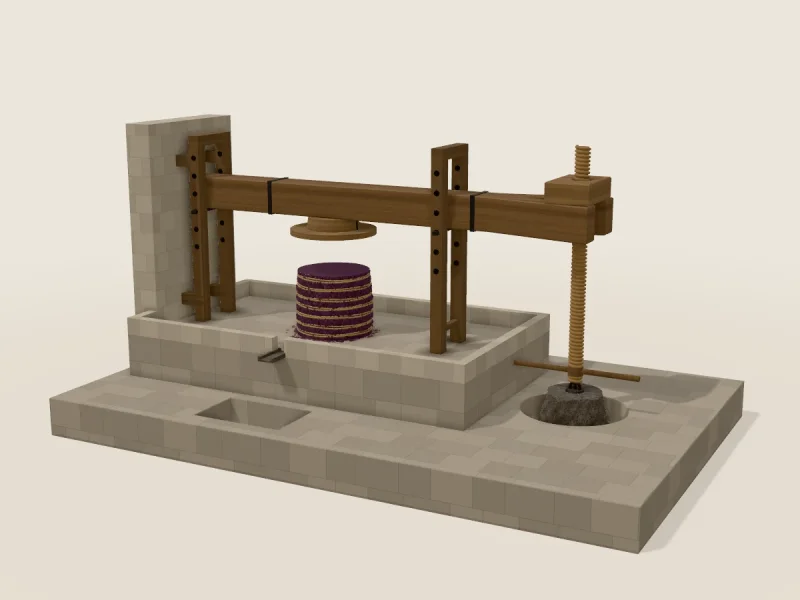
A wine press squeezes the skins left after fermenting so the last of the juice runs out. The old presses of Etna did it without an engine: a 3,000 kg block of lava hung from a 6 to 9 m oak beam, and a wooden screw lifted the stone off the floor.
The surprise is where the force comes from. The men turning the screw do not set it. Once the stone leaves the floor, the weight of the stone and the lever of 2.74 fix the squeeze at about 8.2 tonnes, about 0.5 bar on the pile, and it stays there for two hours with nobody touching it.
Start the model
Move the slider and watch the force gauge: find the moment it stops climbing. That is the stone leaving the floor, and from then on the men can turn all they like.
Watch the film instead (2 minutes, no sound)
What happens, step by step
- The press at rest. The grape skins left after fermenting are stacked in a tall pile and bound with long rush strips. The oak beam waits above, resting on two iron bars.
- Walking the beam down. The beam cannot simply be dropped. The screw tips it one way, an iron bar moves down a hole, the screw tips it back, and the other bar moves down. Twice here.
- Locking the head. The board now sits on the pile. One bar goes above the far end of the beam, so that end can only pivot. The ladder bar goes above the beam too, to stop it rearing up.
- The squeeze. Now each turn pulls the fork down and the beam presses. The force climbs and juice starts to run. The stone is still on the floor, but it is getting lighter.
- The stone leaves the floor. The pile stops giving, so each turn lifts three tonnes of lava instead. The force has stopped climbing: only the stone and the lever set it now.
- Two hours, nobody touching it. The men stop. The stone hangs from the beam and keeps pressing, slow and steady. As the pile gives way the stone sinks, and the force does not change.
- Cut, rebuild, press again. Then the beam goes up, the pile is cut apart and bound again, and the press runs a second time, sometimes a third.
The numbers, and where they come from
| What | Value | Where it comes from |
|---|---|---|
| Weight of the stone | 3,000 kg | Published: Cascone, Pennisi and Di Fazio, 1997, from Caruso's 1869 drawings. A local account at Solicchiata says 3 to 5 tonnes |
| Lever of the beam | 2.74 | Our own reading of an 1869 drawing with no scale: about 2.7 to 2.8 depending on where you measure. No published ratio exists. The ladder sits at a third of the beam, as the paper says |
| Force on the pile | 8.2 tonnes | Our sum: 3,000 kg by gravity by 2.74. At a lever of 2.8 it would be 8.5 tonnes. The beam's own weight adds a little more, so call this a floor |
| Pressure on the pile | 0.5 bar | Our sum on a pile 1.4 m across. Althaus measured 0.55 and 0.47 bar on two presses of the same family in 2021 |
| Time under load | two hours | Published: Caruso, through Cascone. One local account says the stone was left hanging all night |
| Length of the beam | 6 to 9 m | A local account at Solicchiata. No published figure for the beam alone; one restored Etna press runs over 10 m overall. The model uses 7.5 m, and the length does not change the force: only the lever does |
| Men on the screw | 3 to 6 | Published: Cascone. Two to four on the screw at a time |
| Stone off the floor | about 0.8 m | Between two local accounts, about 60 cm and about 1 m |
We looked for a second published figure for the beam's length and the lever and did not find one: the 1869 drawings are not online, the 1997 paper gives the drawing without a scale, and the local accounts give ranges. Where we read a number off a drawing ourselves, the table says so.
Where this press comes from
The palmento was the stone winery of Etna: the grapes were trodden in an upper basin, the juice ran down to ferment in a lower one, and this press stood at the end of the lower basin. You can read about the wines it made on our guide to Etna wine, and about the volcano's side of Sicily and its vineyards.
The skins in the pile were mostly Nerello Mascalese with some Nerello Cappuccio for the reds, and Carricante with a little Catarratto for the whites. A white was often pressed sooner and gentler than a red, which is one reason an Etna white and an Etna red taste so different: see our pages on Italian white wine and Italian red wine.
Two estates on the mountain still keep a palmento with its press. Palmento Costanzo restored one at Passopisciaro and Benanti keeps one at Viagrande. Our guide to visiting Etna's vineyards says how to see one, and the deep dive on Etna wines tells the longer story. The words we use for pressing, must and skins are in the wine glossary, and the rest of our Learn pages cover how wine is made today.
Sources and how this page was made
Sources. Caruso, 1869: the drawings of a palmento press, not online in any copy we found. Cascone, Pennisi and Di Fazio, Informes de la Construccion, vol. 49, no. 450, 1997: the weight of the stone, the position of the ladder, the crew and the two hours, with a redrawing of Caruso's figures; its drawings are stamped non-commercial, so they stay off this page. Althaus, 2021: pressures of 0.55 and 0.47 bar measured on two presses of the same family. Local accounts from Solicchiata, Santa Venera and Palmento La Rosa in Pedara for the beam, the lift of the stone and the night under load.
A simplified model of an 1800s press. We built it with AI tools from published drawings, and checked the forces by hand. Each number says how sure we are. The model draws nothing until you start it, and on a device that cannot draw it the film shows the same machine.
Frequently asked questions
An Etna hanging-stone press puts about 8.2 tonnes on the pile of skins, from a 3,000 kg stone on a lever of 2.74. On a pile 1.4 m across that is about 0.5 bar. A modern pneumatic press works at a similar pressure, up to about 2 bar, but on a bag that squeezes evenly from the side.
A screw held by men gives whatever force they can hold, and it drops the moment they let go. A hanging stone gives a steady, known force for hours: as the pile gives way the stone sinks and keeps pressing, and nobody has to touch it.
Not for wine sold today: EU hygiene rules closed the old stone palmenti for commercial winemaking. Restored presses stand in several estates, where a visit shows the whole machine.