



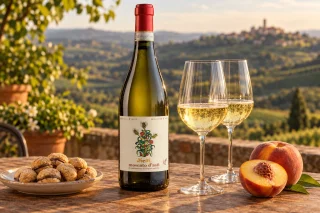


Wine route
Strada del Sagrantino
2 days · 6 stops
Open the driveYour cellar, your trips, and the wines you've been tracking are right where you left them.
New here?
Free, always. Education first, we'll never sell you anything you didn't ask to see.
Already have an account?
Enter the email you signed up with and we'll send a link to choose a new password.
Umbria · DOCG
Montefalco Sagrantino is Umbria's biggest red: 100% Sagrantino from five hill towns around Montefalco, aged more than three years before sale, with more tannin than almost any wine in Italy. A DOCG since 1992, it comes dry, and as a sweet Passito from dried grapes, the way the monks first made it.
Decode the label
One word on the front changes the ageing, the strength and the price.
On the label
Montefalco Sagrantino DOCG
the dry wine, three years in the making
Inky, tannic and built to keep: decant it young, or wait ten years and skip the jug.
In stock from £16.60 See the 20 bottles ↓On the label
Passito
the sweet original
Raisin and fig with firm tannin: blue cheese, dark chocolate, or nothing at all.
In stock from £19.50 See the 3 bottles ↓The boundary
Everything on this page, the estates, the bottles, the sub-zones, sits inside this line.
Wine route
2 days · 6 stops
Open the drive
Estate 1
Montefalco
Tastings available
The zone is a patch of hill country in the middle of Umbria, south of Assisi and east of the Tiber. Montefalco's walled town sits at its centre on a ridge. The vineyards run down its slopes and across into parts of Bevagna, Giano dell'Umbria, Gualdo Cattaneo and Castel Ritaldi, between 220 and 472 metres. There are no sub-zones. The consortium maps four soil types instead: yellow sand around the town, clay and lake sand under Bevagna, river gravel on the valley floors, and marl on the higher ground.
Inside the zone
Click or tap a pin for its estate. The numbered pins match the estate cards below.
Towns worth knowing
Only Montefalco is inside the zone in full; the other four towns contribute the slopes that face it.
In the glass
One profile at a time, never blended into a single set of bars.
Blackberry
Plum
Liquorice
Black pepper
Raisin
Fig

Blueberry

Cinnamon
The disciplinare
The same table on every denomination page, straight from the production rules.
 SagrantinoAlone, dry or dried100%
Solid means the rules demand it. Striped means optional, up to that amount. The words on the right say the same rule.
33 months' ageing before sale, 12 in oak then four months in bottle: no shortcuts to the shelf.
Yields are capped at 8 tonnes per hectare for a grape that gives small, thick-skinned bunches anyway.
Every lot passes a tasting panel before it may carry the DOCG.
Ageing and alcohol minimums per tier are in the label guide above.
Editor's cellar
Live prices, compared across 10 UK retailers.
Cellar doors · inside the zone
One estate inside the zone opens its doors today. A small list, honestly kept: only working cellars with confirmed visits appear here.
No estates match these filters. Clear a filter to see more.
The years
Chart ratings come from the Consorzio Tutela Vini Montefalco's vintage evaluation for Montefalco Sagrantino DOCG (stars out of five, with a score out of 100 from 2017).
Reading the years
Consorzio Montefalco 5/5
The short version: 2015, 2016, 2019 and 2020 are the outstanding years; give any of them a decade.
Tap a year for its note.
The grape is the whole rule: 100% Sagrantino, from vineyards in Montefalco and parts of Bevagna, Giano dell'Umbria, Gualdo Cattaneo and Castel Ritaldi, between 220 and 472 metres. Yields are capped at 8 tonnes a hectare. Both versions must age at least 33 months from the 1st of December after the harvest. The dry wine spends at least 12 of them in oak barrels of any size. After that comes four months in bottle, so no Montefalco Sagrantino reaches a shop less than three years after it was picked. The dry wine must reach 13% (13.5% when a single vineyard is named). For the Passito the bunches dry on racks for at least two months, then ferment on their skins to 18% with 80 to 180 grams of sugar a litre. Everything, drying included, happens inside the zone, and each lot passes a tasting panel before it may use the name.
On the table
Slow-cooked lamb, game, roast pork and aged pecorino: the tannin needs fat, and the Passito wants blue cheese or dark chocolate.
In-depth guide
Blackberry, plum and liquorice with black pepper, cinnamon and tobacco, over some of the firmest tannin in Italy. It is inky, bone dry and 14 to 15%. With ten years in bottle the tannin softens and the fruit turns to prune and fig.
At least 33 months from the 1st of December after the harvest. The dry wine spends at least 12 of them in oak, and both versions then rest four months in bottle. So the earliest a bottle can be sold is a little over three years after the grapes were picked.
Montefalco Sagrantino DOCG is 100% Sagrantino, aged more than three years and built to keep. Montefalco Rosso DOC is a Sangiovese-led blend, 60 to 80% Sangiovese with 10 to 25% Sagrantino, lighter, cheaper and ready sooner.
The sweet version, made the old way. The bunches dry on racks for at least two months, then ferment on the skins to 18% with 80 to 180 grams of sugar a litre. It ages the same 33 months. Expect raisin, fig and blueberry with firm tannin behind the sugar.
Colpetrone's Memoira is the cheapest full DOCG in UK shops at about £20. Arnaldo Caprai's Collepiano at about £29 is the benchmark, and the 25 Anni the icon. Antonelli, Adanti, Scacciadiavoli and Lungarotti sit between £25 and £35.
From about five years after the vintage to twenty. The consortium rated 2015, 2016, 2019 and 2020 as outstanding, 2017 as merely good. Decant a young bottle for an hour and serve it at 18C.