




DOCG
The pinnacle sits directly above this label on the same hills: Barolo, Barbaresco, Roero and Alta Langa. Declassifying from them into Langhe is routine cellar practice, which is why the DOC hides so many serious bottles.
Your cellar, your trips, and the wines you've been tracking are right where you left them.
New here?
Free, always. Education first, we'll never sell you anything you didn't ask to see.
Already have an account?
Enter the email you signed up with and we'll send a link to choose a new password.
Piedmont · DOC · Regional umbrella
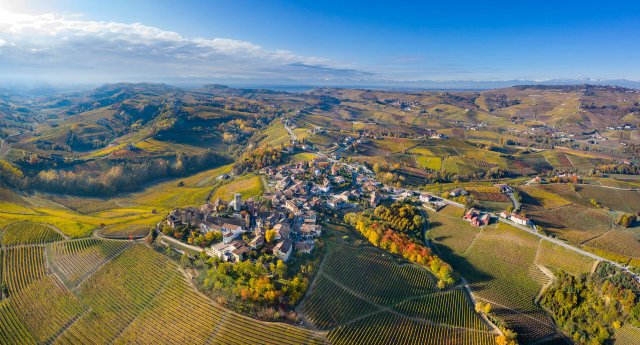
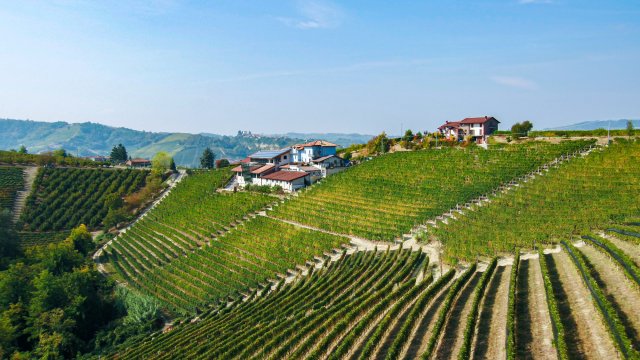
Piedmont's flexible label. Langhe DOC covers the hill country around Alba. The front label can say Nebbiolo, Chardonnay or ten other grapes. It was created in 1994, for a region that refuses to have an IGT. This is where Barolo's second wines and the Langhe's experiments both live.
202
Wines
£12-£495
Price range
25
Retailers

Decode the label
Three levels of Italian wine law, read through Piedmont's own denominations.
DOCG
The pinnacle sits directly above this label on the same hills: Barolo, Barbaresco, Roero and Alta Langa. Declassifying from them into Langhe is routine cellar practice, which is why the DOC hides so many serious bottles.
DOC
Langhe is the widest of the Alba family: Nebbiolo d'Alba, Barbera d'Alba and Dolcetto d'Alba each fence one grape and a tighter zone, while Langhe holds twelve grapes and the whole hill country.
You are hereThe traffic through this label runs in both directions. Gaja moved his single-vineyard Barbarescos into Langhe Nebbiolo from 1996 so the blends could keep a little Barbera, and returned them to Barbaresco DOCG in 2013. The label reads modest; the wine decides.
What DOCG, DOC and IGT mean in Italian law is set out once, in Italian wine zones explained.
Same grape, same hills, different rulebook. Barolo comes from eleven towns and ages 38 months before release. Langhe Nebbiolo covers the wider hill zone, with no long ageing rule. So it drinks young and fragrant, at a third of the price, and often from the same cellar.
Young vines, declassified parcels and cash flow. The DOC lets a Barolo house sell approachable Nebbiolo three years earlier. Vietti's Perbacco and Renato Ratti's Ochetti are the textbook examples.
In red: Nebbiolo, Barbera, Dolcetto and Freisa. In white: Arneis, Chardonnay, Nascetta and Riesling. Cabernet Sauvignon, Merlot, Pinot Nero and Favorita are also admitted. A red named after one grape needs 85 percent of it, a white only 60.
Both. The Langhe are the hills south and east of Alba, a UNESCO World Heritage landscape since 2014. Langhe DOC is the denomination that lets the whole territory bottle under one name.
Regional policy. Piedmont chose to classify everything under DOC and DOCG, rather than adopt the IGT tier. Langhe DOC does the job an IGT does elsewhere. That is why its rules are the loosest in the Alba system.
The territory
Everything drawn here can also, or instead, carry the Langhe DOC label.
The territory is the administrative region, nothing tighter. Every stricter denomination on this map is drawn inside that same line, which is why a grower in one of them can bottle under either name in the same harvest.
None of these zones belongs to Langhe DOC. They sit in the same territory and answer to their own rulebooks.

From Barolo's tannic spine to Asti's gentle fizz, Piedmont turns Nebbiolo, Barbera, Moscato, and Cortese into Italy's most cru-mapped wine country.
An umbrella of this size covers every style of still and sparkling wine. Each link below opens a filtered listing.
Editorially selected bottlings. 12 from 202.
 3 retailers
Langhe
3 retailers
£275.00
 3 retailers
Langhe
3 retailers
£280.00
 6 retailers
Langhe
6 retailers
£19.00
 5 retailers
Langhe
5 retailers
£19.25
 5 retailers
Langhe
5 retailers
£19.72
 5 retailers
Langhe
5 retailers
£75.84
 4 retailers
Langhe
4 retailers
£19.01
 4 retailers
Langhe
4 retailers
£20.50
 4 retailers
Langhe
4 retailers
£21.48
 4 retailers
Langhe
4 retailers
£25.00
 4 retailers
Langhe
4 retailers
£49.09
 3 retailers
Langhe
3 retailers
£14.50
Sibling appellations that share Piedmont’s soil and sky.
 1,546 wines
 62 denominations