







 37 wines
 1 denominations








Chardonnay is a white grape with a clear Italian role.
Wines
626
Acidity
Body
White Grape · Aosta Valley
The featherlight alpine white of Valle d'Aosta, Prié Blanc ripens in some of Europe's highest vineyards on ungrafted, own-rooted vines that phylloxera never reached below Mont Blanc, tasting of lemon, cold stone and mountain air.
Prié Blanc is the lone native white grape of Valle d'Aosta. It ripens between 900 and 1200 metres, in the Valdigne foothills of Mont Blanc. It is the sole grape behind Valle d'Aosta DOC Blanc de Morgex et de La Salle. That alpine white grows on ungrafted, low pergola vines. The vines sit around the municipalities of Morgex and La Salle, in north-west Italy.
Your cellar, your trips, and the wines you've been tracking are right where you left them.
New here?
Free, always. Education first, we'll never sell you anything you didn't ask to see.
Already have an account?
Enter the email you signed up with and we'll send a link to choose a new password.
Setting it straight
The anchor fact: After phylloxera swept Europe in the late 1800s, almost every vine was grafted onto pest-resistant American rootstock to survive. At 900 to 1,200 metres below Mont Blanc it is too cold and sandy for the louse, so Prié Blanc still grows ungrafted on its own roots.
Taste · Where it sits
Forget scores out of five. Here’s Prié Blanc described against grapes you already know.
The short season at 900 to 1,200 metres keeps the berries tiny, so the wine weighs almost nothing on the palate, closer to cold mountain water than to a sun-ripened southern white.
There is next to no tannin here; the wine's whole frame is acidity and altitude, not skin grip.
Cold nights at altitude lock the acidity in, giving a lemon-sharp, mouth-watering line that makes Prié Blanc a natural base for high-altitude sparkling.
Bone-dry and citrus-lit, all green apple and lemon zest rather than ripe orchard fruit, though a rare sweet version is made too.
Key flavours






The map
Prié Blanc is light-bodied, crisp, fresh acidity, mapped against other white grapes you can buy. The closer a grape sits, the more its weight and freshness resemble Prié Blanc.
Is this for you?
Reach for it when…
Maybe skip it if…
Serving guide
Serve at
8-10°C
Serve it properly cold, 8 to 10°C, so the alpine acidity stays crisp and the delicate lemon-and-herb aromatics do not blow off.
Decant
Not needed
No decanting; there is nothing to soften here, and air only costs you the mountain freshness that is the whole point.
Glass
Sauvignon Blanc Glass
A narrower Sauvignon Blanc glass funnels the fine citrus and white-flower aromatics without letting this featherlight wine spread thin.
Drink within
2-3 days
Once open it holds its nervy freshness for two to three days in the fridge, though it is at its best on day one.
Cellar
1-4 years
Best drunk young, inside one to four years while the acidity stays electric, though top still and metodo classico bottlings can hold longer.
Where it grows


Italy's smallest wine region clings to terraces between 500 and 1,200 metres, where Prie Blanc, Petit Rouge and Picotener (Nebbiolo) catch the alpine sun.
The terroir
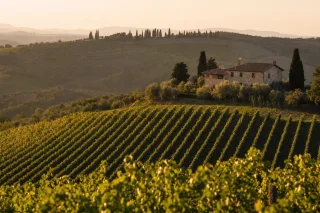
Prié Blanc lives almost entirely in one place, the upper Valle d'Aosta around Morgex and La Salle, where vineyards climb the moraine slopes below Mont Blanc to some of the highest points wine is grown in Europe. Sandy glacial soils and brutal cold keep phylloxera away, so the vines grow ungrafted on their own roots, trained low on pergolas to steal warmth from the stony ground.
Morgex & La Salle
Upper Valle d'Aosta, directly below Mont Blanc
The classic featherlight still white, lemon, green apple and cold stone at 900 to 1,200 metres
The ungrafted terraces
Sandy glacial moraine, roughly 900 to 1,200 metres and above
Own-rooted, pre-phylloxera vines on low pergolas, some of the highest and rarest vineyards in Europe
High-altitude sparkling
The same alpine fruit, held back for a second fermentation
Taut, mountain-fresh metodo classico, the altitude's piercing acidity turned into fine bubbles
Editorial
Prié Blanc is one of the oldest grape varieties of the Valle d'Aosta. It was first documented in 1691, in a sale of vines near the hamlet of Saint-Pierre. The origin of the name is debated. One synonym, Blanc du Valdigne, points to the upper Aosta valley that climbs toward Mont Blanc. Another, Agostena, may come from Augusta Praetoria, the Latin name of Aosta. It may instead come from agosto, the early-August harvest window for this fast-ripening variety.
Below Mont Blanc, phylloxera never climbed high enough to reach the vines, so Prié Blanc still grows the old way, ungrafted and on its own roots, in vineyards near the roof of Europe.
Blanc de Morgex et de La Salle, upper Valle d'AostaGenetic work has tied Prié Blanc to the Spanish white grapes Albillo of Ribera del Duero and Lairén of Andalusia. It has also tied the grape to the Valle d'Aosta natives Mayolet, Primetta and Roussin de Morgex, all of which it has parented. Through Primetta it is also a grandparent of the Swiss Rouge du Pays.
In the vineyard, Prié Blanc is famously franco di piede. Phylloxera does not survive at the 900 to 1200 metre altitudes of the upper Valdigne. So the vines are ungrafted. They are trained low, on traditional pergola systems that catch ground heat and protect young shoots from frost. The Valdigne clone is now the only one in commercial use, anchored to the municipalities of Morgex and La Salle.
In style, the grape covers more ground than its small footprint suggests. The still version, Valle d'Aosta DOC Blanc de Morgex et de La Salle, is bright, steely and floral. Classic-method spumante adds creamy length to that piercing acidity. A traditional flétri sweet wine and a rare ice wine complete the range, which comes from one of Europe's highest commercial vineyards. The ice wine is harvested in late December, below freezing.
Good to know
Prié Blanc is a white wine grape native to Valle d'Aosta in north-west Italy. It is the only grape allowed in Valle d'Aosta DOC Blanc de Morgex et de La Salle. Those wines are grown around the municipalities of Morgex and La Salle.
Prié Blanc wines are light-bodied, bone-dry and very high in acidity. They show green apple, mountain herbs, mint, chlorophyll and white flowers. They often finish on a steely, stony note.
Almost all Prié Blanc goes into Valle d'Aosta DOC Blanc de Morgex et de La Salle. That wine can be still or classic-method sparkling. More rarely it is a flétri sweet wine or an alpine ice wine.
Prié Blanc is grown almost entirely in the upper Valdigne of Valle d'Aosta. The vines sit around Morgex and La Salle, between roughly 900 and 1200 metres above sea level. They are ungrafted and trained low on traditional pergolas.
The phylloxera root louse cannot survive at the 900 to 1200 metre altitudes of the upper Valdigne. So Prié Blanc vines are franco di piede. They are planted on their own roots, as most European vineyards were before phylloxera.
The bright, high-acid still wine works with Valdostan classics like fontina fondue, polenta concia and freshwater fish. The classic-method sparkling handles aperitivo and prosciutto crudo. The flétri sweet styles match aged blue cheeses and chestnut desserts.
No. Prié Blanc is a white grape grown in the upper Valle d'Aosta. Prié rouge is a different, unrelated variety. Italian grape studies now identify it with the local red grape Bonda.
Explore by style
Jump to the editorial guide for each style this grape turns up in.
Keep exploring