








How Orange Wine is Made
TL;DR
- Orange wine is made by fermenting white grapes with their skins left in, the same skin contact that gives red wine its colour and grip.
- The length of that skin contact, from a few days to several months, is the biggest choice the winemaker makes, and it decides how deep the amber colour and how firm the tannins become.
- Italy leads the modern style from Friuli-Venezia Giulia, where growers such as Gravner and Radikon revived it using Ribolla Gialla and buried clay amphorae.

In a nutshell
Orange wine is not made from oranges. It is a white wine made in the way you would normally make a red wine, by leaving the grape skins in contact with the juice while it ferments. That single decision changes everything: the wine takes on a colour that ranges from bright gold to deep amber, a gentle tannic grip you almost never find in a white, and aromas of dried fruit, nuts and tea.
The style is often called skin-contact wine, macerated white, or amber wine, and in Italy you will see it grouped as Italian orange wines. It is really a revival rather than an invention. Winemakers in the Caucasus were fermenting white grapes on their skins in buried clay vessels thousands of years ago, and modern Italy, above all Friuli, brought the method back to the world stage. The steps below follow a bottle from harvest to cellar.
Step 1: White grapes chosen for the skins
Every orange wine starts with white grapes, the same fruit that would otherwise become a crisp white wine. What matters is that the skins are healthy, ripe and full of flavour, because here the skins are not thrown away. They will sit in the wine for weeks, so any underripe or rotten fruit would show through plainly in the glass. Growers tend to favour thick-skinned, characterful varieties that have enough substance to stand up to a long soak, rather than the most delicate, perfumed grapes.
Italy's heartland for the style is Friuli-Venezia Giulia in the north east, where the classic grapes are Ribolla Gialla, Friulano, Malvasia Istriana and Pinot Grigio. Pinot Grigio is a natural fit, because its skins are already a coppery pink, and left in contact they give the old ramato, or coppery, wines their gentle glow. That local habit of leaving Pinot Grigio a little colour is one of the threads the modern movement picked up and pushed much further.
Further south the method travels well too. You will find it made from Garganega around Soave in the Veneto, from Verdicchio in the Marche, from Trebbiano in central Italy, and from island grapes such as Sicily's Grillo. The grape sets the aromatic starting point, but from here on it is the winemaker's hand, above all the length of skin contact, that decides the style.
Step 2: Crushing and keeping the skins
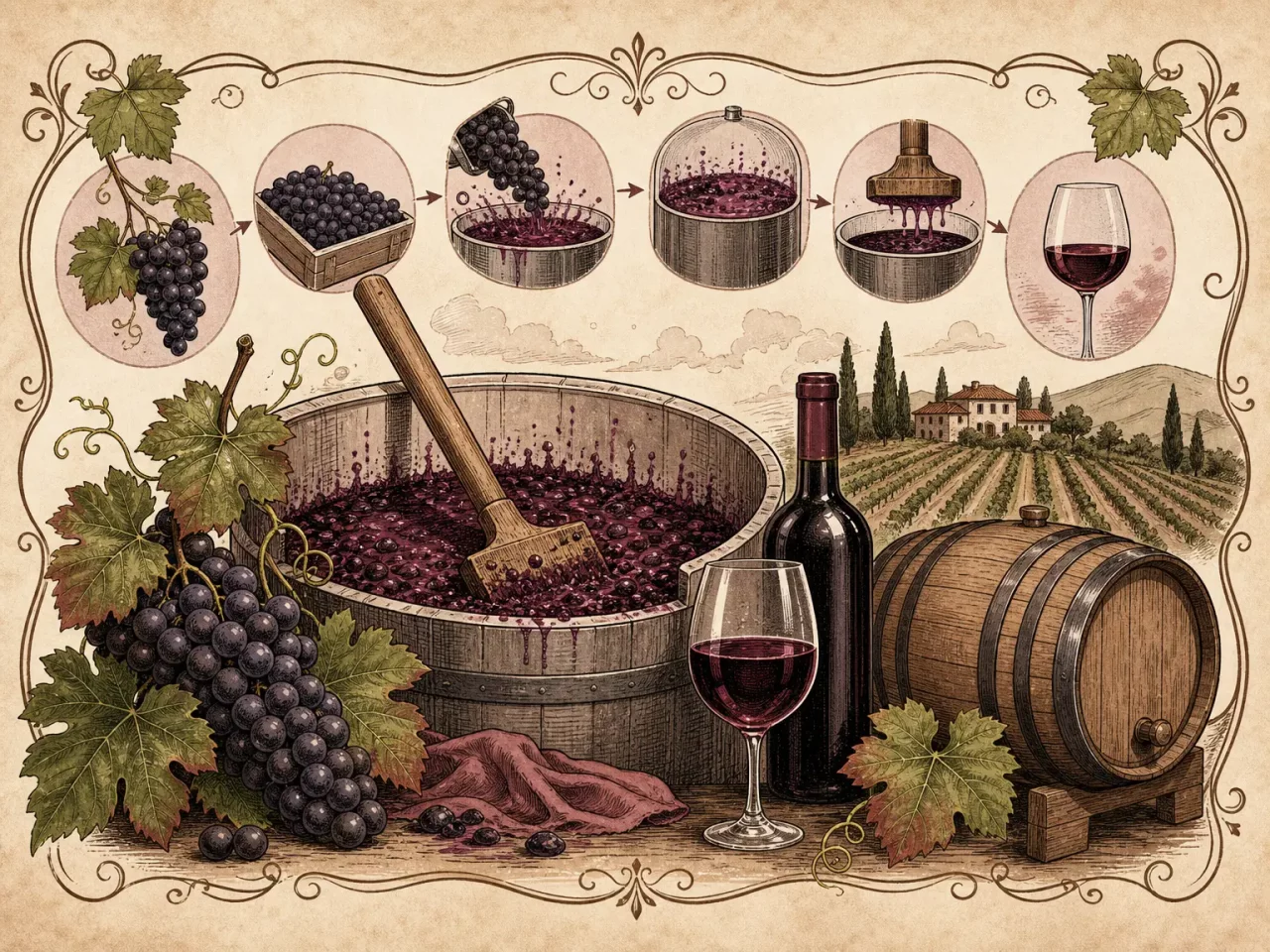
Once the grapes reach the cellar they are usually destemmed and gently crushed, exactly as they would be for many other wines. The fork in the road comes next. To make a white wine, the winemaker presses the juice away from the skins straight away and ferments the clear juice alone.
For orange wine, that pressing is delayed. The crushed grapes, skins, pulp and seeds go into the fermenting vessel together as one mass, often called the must. Keeping the solids in is the whole point, and it is the same starting move a producer uses for red wine. From this moment the wine is being built by contact, not by juice alone. Because the seeds, and sometimes the stems, stay in the mix, the fruit has to be judged carefully at harvest, since harsh or unripe seeds would push green, bitter flavours into the finished wine.
Step 3: Maceration, the heart of orange wine
Maceration is the stretch of time the juice spends soaking on the skins and seeds, and it is where orange wine is truly made. As the fruit sits, the skins release colour pigments, aromatic compounds and tannins, the drying, grippy substances that a white wine normally never picks up. The longer the soak, the deeper the colour and the firmer the grip.
That soak can last anywhere from a few days to several months. A short maceration of a week or two gives a pale, delicate wine with a coppery tint and only a whisper of structure. A long one of many weeks pushes the colour toward deep amber and builds a real tannic frame. In Friuli a maceration of around a month is common, while the region's most uncompromising names have famously left the wine on its skins for six months or more.
During maceration the skins float up and form a cap on top of the liquid. To keep flavour and colour moving into the wine, the cellar team pushes that cap back down or pumps juice over it, gently and by hand in the most traditional cellars. It is slow, watchful work, and it is why no two orange wines taste quite alike.
Step 4: Fermentation, often wild and hands-off
While the skins soak, fermentation is under way. This is the stage every wine shares, where yeast turns the grape sugars into alcohol, and you can read the basics in our guide to winemaking. What sets the orange style apart is how little the winemaker interferes.
Most orange wines are fermented with wild, or native, yeast, the natural population that lives on the grape skins and in the cellar, rather than a packaged yeast added by hand. Fermentation tends to run a little warmer than it would for a fresh white, which helps draw flavour from the skins. Keeping the floating skins as a protective cap on top also shields the wine from the air during this busy stage, which is one reason so little needs to be added to keep it sound. This hands-off, low-intervention approach is why so many orange wines sit close to the natural wine movement, made with as few additions as possible from grape to bottle.
Step 5: The vessel, from amphora to oak
The container the wine ferments and rests in shapes the final style as much as the grape. The oldest choice, and the one most tied to orange wine's story, is clay. Buried terracotta amphorae, known in Georgia as qvevri, let the wine breathe a little through their porous walls without adding any flavour of their own.
It was a journey to Georgia that led the Friulian grower Josko Gravner to adopt qvevri for his Ribolla Gialla from the 2001 vintage, burying the clay eggs in his cellar floor to hold a steady, cool temperature. That move, alongside the long-maceration wines of his neighbour Stanko Radikon, helped define the modern category and drew growers from across Italy to visit and copy the idea.
Not every producer uses clay. Many reach for large, old oak casks, concrete tanks, or plain stainless steel. The common thread is that the vessel is usually neutral, chosen to let the skin contact, rather than new oak, do the talking. That is a very different goal from the small toasty barrels often used to build a rich, buttery white wine, and it keeps the focus on fruit, texture and the savoury notes the skins provide.
Step 6: Pressing off and ageing
When the winemaker judges the maceration complete, the wine is drained off and the soaked skins are pressed to squeeze out the last of the liquid. Now, at last, the wine and the skins part ways. What follows is often a long, patient ageing, far longer than a bright white would ever see.
Orange wines are frequently aged for months or even years, commonly in those same neutral vessels, and often with gentle exposure to air. That slow, slightly oxidative rest is what settles the colour into stable amber and softens the young tannins into something smoother. Along the way the bright, primary fruit of youth fades and more savoury notes of dried fruit, nut and honey step forward, the hallmark of a wine that has spent real time in the cellar. Italy's benchmark producers may hold a wine back for several years before it is released, so the bottle you buy has already done much of its growing up.
Step 7: Racking, gentle fining and bottling
As the wine rests, solids drift to the bottom and the clear wine is drawn off the sediment, a step called racking. Here again the orange approach is light-handed. Many producers add little or no fining agent, filter gently or not at all, and keep added sulphur low, all in the spirit of minimal intervention.
The result is a wine that can look cloudy or hazy in the glass and may throw a little sediment in the bottle, which is normal and not a fault. Once the winemaker is happy, the wine is bottled, very often unfiltered, and left to settle before it goes on sale. It is a style that rewards a little patience, so a young, tightly wound orange wine will often relax and open up after some time in the glass or a decanter. Every one of these small, low-touch choices is a deliberate part of the house style.
Why this process tastes different
Trace the amber colour, the grippy texture and the savoury aromas back, and they all lead to the same place: skin contact. The extra time on the skins is what turns fresh citrus and orchard fruit into notes of dried apricot, orange peel, walnut, black tea and dried herbs, while the tannins drawn from skins and seeds give the wine a chewy, almost tea-like grip on the finish. Nothing has been added to create those flavours; they are simply what the fruit gives up over a long maceration.
Because an orange wine is built like a red wine but from white grapes, it lands in a space of its own, firmer and more textured than a white wines, yet fresher and more aromatic than most red wines. It is neither the pale pink of a rose nor the fizz of a sparkling wine, which is exactly why Italy treats it as a fourth style in its own right rather than a curious kind of white.
If you would like to see which bottles carry this method into the glass, and how to serve and pair them, explore our full guide to Italian orange wines. Understanding how the wine is made is the surest way to know what you are tasting.
Frequently asked questions
Not quite, although the two often overlap. Orange wine describes a method, fermenting white grapes on their skins, while natural wine describes a philosophy of adding and removing as little as possible. Many orange wines are made in a low-intervention, natural style, with wild yeast and minimal sulphur, which is why the labels sit side by side so often. You can, however, make an orange wine with more conventional cellar tools, and plenty of natural wines are ordinary reds and whites.
Anywhere from a few days to several months, and that choice is the single biggest lever a winemaker has. A short soak of a week or two gives a pale, delicate wine with a coppery tint, while many weeks on the skins build a deep amber colour and a firm, drying grip. In Friuli-Venezia Giulia around a month is common, and the region's most extreme wines can spend six months or more macerating before they are pressed off.
Clay is the oldest vessel for the style, going back to the buried qvevri of ancient Georgia. Porous terracotta lets the wine breathe gently without adding any flavour of its own, so the fruit and the skin contact stay centre stage. The Friulian producer Josko Gravner brought the method back to prominence when he began fermenting his Ribolla Gialla in qvevri from the 2001 vintage, and it remains a signature of many benchmark Italian orange wines.
Yes, and that is its most surprising trait. During maceration the grape skins and seeds release tannins, the same drying, grippy compounds that give a red wine its structure. Because a normal white wine never touches its skins for long, it stays soft and tannin-free. Orange wine sits in between, keeping the freshness of a white while gaining a genuine tannic frame from all that skin contact.
A hazy look is usually a sign of how gently the wine was handled, not a fault. Many orange winemakers work in a minimal-intervention style, adding little or no fining agent, filtering lightly or not at all, and keeping added sulphur low. That leaves natural particles in the wine, so it can look cloudy and may drop a little sediment in the bottle. Standing the bottle upright for a day and pouring slowly will leave any sediment behind.
The spiritual home is Friuli-Venezia Giulia in the north east, especially the Collio, Oslavia and Carso hills near the Slovenian border, where Ribolla Gialla and Malvasia Istriana lead the way. The method has since spread across the country, from Garganega grown for Soave in the Veneto to Sicilian island grapes, as more growers experiment with skin contact and revive an old local tradition.