







 274 wines
 19 denominations


Chardonnay is a white grape with a clear Italian role.
Wines
635
Acidity
Body
White Grape · Abruzzo
Italy's most workaday white-wine name hides a secret: Trebbiano Abruzzese is a distinct Abruzzo variety, unrelated to bulk Trebbiano Toscano, that in the hands of Valentini and Emidio Pepe ages for decades into one of the country's greatest whites.
Trebbiano Abruzzese is the white grape behind Abruzzo's most distinctive whites. Among them are the bottlings of Valentini, Emidio Pepe and Tiberio, which have texture and age well. For a long time it was mixed up with Trebbiano Toscano, but it is a separate grape. It is native to the Adriatic foothills between the Gran Sasso and the Majella. It is also the main grape allowed in the Trebbiano d'Abruzzo DOC.
Your cellar, your trips, and the wines you've been tracking are right where you left them.
New here?
Free, always. Education first, we'll never sell you anything you didn't ask to see.
Already have an account?
Enter the email you signed up with and we'll send a link to choose a new password.
Clearing it up
The true Abruzzo grape
Italy's workhorse white
The anchor fact: No. Trebbiano Abruzzese and Trebbiano Toscano are two unrelated grapes that merely share the Trebbiano name. Toscano is Italy's most-planted, high-yield, near-neutral workhorse white; Abruzzese is a rare, structured Abruzzo variety that can age for decades. To muddy it further, a bottle simply labelled Trebbiano d'Abruzzo may be made from either, so the name on the front is no promise of the grape inside.
Taste · Where it sits
Forget scores out of five. Here’s Trebbiano Abruzzese described against grapes you already know.
Real weight for a white without any heaviness: a savoury, mid-weight body built on extract and time on the lees rather than ripe fruit or oak, so it carries food almost like a light red, a world away from a thin, neutral supermarket Trebbiano.
A white, so no true tannin, but a fine phenolic and saline grip on the finish: the textural chew that lets it stand up to food and to years in bottle, and that a neutral Trebbiano simply never has.
The engine of its long life: a firm, mouth-watering acidity that reads more mineral than citric, holding the wine taut in youth and driving the decades of ageing the great bottles are famous for.
Always bone dry and firmly savoury: what fruit shows is a restrained white peach and blanched almond, wrapped in nettle, wet stone and salt rather than in any sweetness or tropical flash.
Key flavours



The map
Trebbiano Abruzzese is medium-bodied, crisp, fresh acidity, mapped against other white grapes you can buy. The closer a grape sits, the more its weight and freshness resemble Trebbiano Abruzzese.
Is this for you?
Reach for it when…
Maybe skip it if…
Serving guide
Serve at
10-12°C
Serve it cool but not ice-cold, around 10 to 12C: over-chill it and you flatten the almond, salt and savoury texture that separate a real Trebbiano Abruzzese from a neutral one.
Decant
No
No need to decant a young bottle, though a mature Valentini or Emidio Pepe can take a little air to unfurl its honey, wax and nutty depth.
Glass
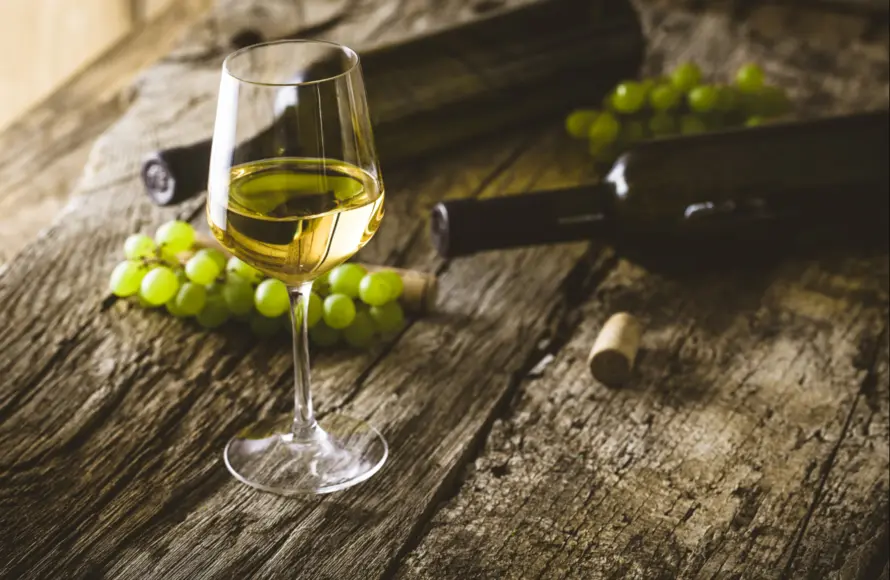
Chardonnay Glass
Pour it into a broad Chardonnay-style bowl: this is a textured, structured white, and the wider glass gives its body and savoury aromatics room rather than funnelling it like a crisp aperitivo.
Drink within
3-5 days
An open bottle holds three to five days in the fridge; the firm acidity and phenolic grip keep it going well past a fragile, neutral white.
Cellar
5-15 years
One of Italy's genuinely ageworthy whites: a serious bottle rewards five to fifteen years, and the legends from Valentini and Emidio Pepe drink gloriously at twenty or thirty, trading nettle and stone for honey, wax and toasted almond.
On the table
Start with the home-table matches that made the grape, then browse the full cuisine library.

Abruzzo's guitar-string pasta
Cut on the chitarra's wires and dressed with the region's lamb-and-tomato ragu or tiny pallottine meatballs, this is Abruzzo on a plate; the wine's savoury body meets the meat while its mineral acidity lifts the tomato, a match straight from the grape's own hills.

Adriatic fish stew
Giulianova's saffron-and-pepper mixed-fish brodetto sits right on Trebbiano Abruzzese's own coast; the wine's salinity echoes the sea while its structure and firm acid carry the tomato and chilli where a thin, neutral white would simply drown.

Teramo's crepes in broth
Scrippelle 'mbusse, thin crepes rolled and bathed in hot chicken broth, are a delicate Teramo comfort dish; the wine's gentle almond note and saline length flatter the brothy, eggy softness without overpowering it, showing its quieter, finer side.

The mountain grill
Abruzzo's rite of charcoal-grilled mutton skewers is usually red-wine turf, but a structured Trebbiano Abruzzese has the phenolic grip and firm acidity to cut the charred fat, a fresher, saltier foil pulled straight from the same hills.
Browse every pairing
Denominations
The appellations where Trebbiano Abruzzese plays a starring role.
Where it grows


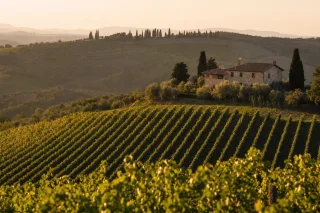
Abruzzo runs from Gran Sasso to the Adriatic, turning Montepulciano into dark reds, Cerasuolo rosato and a new wave of Pecorino and Trebbiano whites.
The terroir
Trebbiano Abruzzese is a grape of Abruzzo's hills, not its fertile plains. It gives its structured, mineral best on the higher inland slopes below the Gran Sasso and the Maiella, where cool nights and poor soils rein in its vigour; down on the warm coastal flats it slides towards the bulk, neutral wine the name is unfairly known for. Where it grows, and who grows it, decides everything.
Loreto Aprutino and the Pescara hills
The inland hill country of Pescara province, below the Gran Sasso
The artisan heartland: home to Valentini and to Tiberio's massale-selected old vines, where low yields on poor hill soil make the most structured, ageworthy, mineral Trebbiano of all.
The Colline Teramane
Torano Nuovo and the Teramo hills of northern Abruzzo
Emidio Pepe's country near the Gran Sasso foothills, where the grape is foot-trodden and cellared for years to prove a white can age: austere and saline in youth, honeyed and profound with time.
The coast and the plains
The Adriatic flats of Chieti and Pescara
The volume home of Trebbiano d'Abruzzo, much of it high-yielding Trebbiano Toscano or Bombino Bianco rather than the true variety: pleasant, neutral, everyday wine that saddled the name with its workaday reputation.
Editorial
Trebbiano Abruzzese sits inside one of the longest-running mix-ups in Italian wine. For decades the grape was treated as the same thing as Trebbiano Toscano. That is the high-yielding workhorse known in France as Ugni Blanc. Genetic studies have since made it clear that Trebbiano Abruzzese is a separate, native grape. So has the work of writers such as Ian d'Agata. It grows in Abruzzo and almost nowhere else, and older vineyards often carry Bombino Bianco and Passerina alongside it.
When Emidio Pepe began cellaring his Trebbiano d'Abruzzo in the 1960s, releasing it only years later, his neighbours thought him eccentric: no one believed a Trebbiano could age. Sixty years on, his and Valentini's decades-old whites are among Italy's most coveted bottles, proof that this grape, alone among the Trebbianos, was built to last.
Emidio Pepe, Torano Nuovo, from 1964The Trebbiano d'Abruzzo DOC was set up in 1972. Any of Trebbiano Abruzzese, Trebbiano Toscano or Bombino Bianco could make up the required 85 percent of the blend. That open rule is why commercial Trebbiano d'Abruzzo varies so much in style. The cheapest bottles are usually Trebbiano Toscano. The most ambitious are pure or near-pure Trebbiano Abruzzese.
The grape's serious champions live in the Pescara and Teramo provinces. In Loreto Aprutino, Valentini has bottled some of Italy's longest-lived whites since the 1960s. They go out under the Trebbiano d'Abruzzo label. In Torano Nuovo, Emidio Pepe works without temperature control or stabilisation, and the wines age for decades in bottle. At Cugnoli, Tiberio has restored old massal-selection vineyards. The estate has set the modern benchmark for what pure Trebbiano Abruzzese tastes like. In Popoli, Valle Reale farms cool sites high up between the Gran Sasso and the Majella.
In the glass the grape gives a straw-yellow to golden colour. The aromas are restrained: marzipan, nettle, caper flower and white peach. The mid-palate has texture, built on a salty, stony feel rather than upfront fruit. Acidity drops quickly when the grape over-ripens, and the must oxidises easily. So harvest timing and reductive winemaking matter more here than in almost any other Italian white.
Good to know
Trebbiano Abruzzese is a native white grape. It grows in Abruzzo and almost nowhere else, on Italy's central Adriatic coast. It is the main grape allowed in the Trebbiano d'Abruzzo DOC. Its genes set it apart from the more common Trebbiano Toscano.
No. Trebbiano Abruzzese is the grape. Trebbiano d'Abruzzo is the DOC wine made from it. The DOC also allows Trebbiano Toscano and Bombino Bianco. So a bottle labelled Trebbiano d'Abruzzo is not always pure Trebbiano Abruzzese.
Genetic studies show the two are not related. Trebbiano Toscano is a high-yielding blending grape, planted widely across central Italy and used for Cognac in France. Trebbiano Abruzzese is a lower-yielding native of Abruzzo. Farmed with care, it can give whites with texture that age well.
Pure Trebbiano Abruzzese is restrained on the nose. Look for marzipan, nettle, caper flower, white peach and crushed almond. The palate is dry and salty rather than tropical. It has stony length and a fine line of acidity that holds up over years in bottle.
The benchmark estates are Valentini in Loreto Aprutino, Emidio Pepe in Torano Nuovo, Tiberio in Cugnoli and Valle Reale in Popoli. Cataldi Madonna and Masciarelli also bottle credible Trebbiano d'Abruzzo at lower prices.
Yes. Top examples from Valentini, Emidio Pepe and Tiberio drink well at 10 to 20 years and beyond. The grape has high natural acidity and a mid-palate with texture. It is also aged on the spent yeast by tradition. That gives it the structure to evolve, and it gains honeyed, salty complexity in bottle.
Lean fish dishes from the Adriatic, such as brodetto vastese, grilled sea bream and stoccafisso all'abruzzese. Pasta alla chitarra with seafood, lamb arrosticini, pecorino di Farindola and chickpea-based primi all suit the grape too. Its profile is salty and stony.
Explore by style
Jump to the editorial guide for each style this grape turns up in.
Keep exploring