














Chardonnay is a white grape with a clear Italian role.
Wines
635
Acidity
Body
White Grape · Lazio
Malvasia Bianca di Candia is the quiet, non-aromatic half of the Candia line: a soft, sapid, oxidation-prone white that is the historic backbone of Rome's Frascati, carrying the Venetian name for Crete but none of the muscat perfume of its aromatic Emilian cousin.
Malvasia di Candia is a white grape with two faces. One is a workhorse strain that anchors the Lazio whites of Frascati DOCG and the Castelli Romani. The other is Malvasia di Candia Aromatica, a genetically distinct, perfumed Emilian clone. It defines Colli Piacentini DOC and Colli di Parma DOC.
Your cellar, your trips, and the wines you've been tracking are right where you left them.
New here?
Free, always. Education first, we'll never sell you anything you didn't ask to see.
Already have an account?
Enter the email you signed up with and we'll send a link to choose a new password.
Clearing it up
Lazio, the Castelli Romani south of Rome
Emilia, the Piacenza and Parma hills
The anchor fact: Two distinct grapes hide behind the word Candia. This site's grape is the non-aromatic Malvasia Bianca di Candia of Lazio, not the aromatic Malvasia di Candia Aromatica of Emilia.
Taste · Where it sits
Forget scores out of five. Here’s Malvasia di Candia described against grapes you already know.
A soft, mid-weight, faintly glyceriny white with just enough flesh to give a Frascati some breadth. It oxidises readily, which is why growers prop it up in a blend rather than bottle all that roundness on its own.
Pressed straight off its skins, so there is no tannin to find; the only grip is the bitter-almond twist on the finish, a varietal tell rather than any real structure.
Middling acidity rescued by a briny sapidity drawn from the tufa and pozzolana of the Roman hills: fresh enough for a cold carafe, but never the taut, citrus spine of a mountain white.
Made bone-dry in Frascati, its fruit reads as soft peach, apple and apricot rather than sugar. Only lees contact or a few years coax out the honeyed, malmsey side the Candia name once carried.
Key flavours





The map
Malvasia di Candia is medium-bodied, balanced acidity, mapped against other white grapes you can buy. The closer a grape sits, the more its weight and freshness resemble Malvasia di Candia.
Is this for you?
Reach for it when…
Maybe skip it if…
Serving guide
Serve at
10-12°C
Serve it cold, 10 to 12 C, the way Rome pours it; let it warm and the soft, oxidation-prone fruit turns flat and heavy.
Decant
No
No decanting: there is no tannin to unwind, and what little hawthorn-and-almond aroma it has only tires with air.
Glass
Tulip Glass
A tulip glass gathers the modest hawthorn-and-peach scent; the grape gives too little perfume to waste in a wide bowl.
Drink within
2-3 days
Drink it young, inside two to three years, while the peach and apple are still fresh; this is a carafe wine, not a keeper.
Cellar
1-3 years
Little to gain from the rack: the grape browns and dries out quickly, which is exactly why it has always lived in blends rather than aged alone.
Buy it · three to start with
A curated trio across the price range, then every Malvasia di Candia on sale in the UK right now.
3 bottles
 2 retailers
Lazio
2 retailers
£13.24
 1 retailer
Emilia / dell'Emilia
1 retailer
£13.60
 1 retailer
Appellation TBD
1 retailer
£13.90
Where it grows

Lazio is Frascati country with a serious red side. Volcanic whites from the Castelli Romani, Cesanese on the Ciociaria hills, and a Roma DOC reaching for Read more

Italy's pasta plains pour fizzy Lambrusco from Modena and Reggio, ageworthy Sangiovese di Romagna, Albana DOCG whites, and Bologna's gentle Pignoletto. Read more

From Franciacorta classic-method bubbles to Valtellina mountain Nebbiolo and Lugana lake-cool whites, Lombardy spans 5 DOCGs across roughly 25,000 hectares of Read more

From Vesuvian ash to Avellino's Tufo hills, Campania pours four DOCGs of Italy's deepest wine memory: Aglianico for thunder, Fiano and Greco for stone-cool Read more

From Castelli di Jesi Verdicchio to Conero Montepulciano and Offida Pecorino, Marche covers 5 DOCGs across roughly 16,500 hectares of Adriatic and Apennine Read more
The terroir
Malvasia Bianca di Candia is central Italy's soft-white workhorse, most itself on the volcanic hills southeast of Rome and a quiet blending hand across the regions around it.
The Castelli Romani
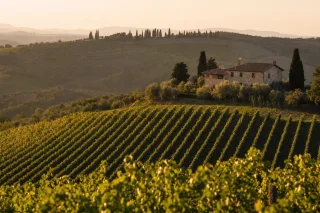
The volcanic hills southeast of Rome, in Lazio.
Straw-gold and faintly saline on tufa and pozzolana soils, this is its heartland: the historic backbone of dry Frascati, Marino and Colli Lanuvini, rounded out with Trebbiano and the finer Malvasia del Lazio.
Emilia-Romagna
The Piacenza and Parma hills of the north.
Here the plain Bianca di Candia lives in the shadow of its aromatic namesake: it stays a quiet blender while Malvasia di Candia Aromatica takes the perfumed billing on local labels.
Le Marche
The Adriatic side of central Italy.
A minor, softening presence, lending low-acid roundness and orchard flesh to blends built on the region's crisper native whites.
Editorial
The "di Candia" name points to the old Greek port of Candia, on Crete. That was the route Venetian and Byzantine merchants used to ship sweet Mediterranean whites into Italy. Modern Italian vine records list two distinct vines under that one name. Malvasia Bianca di Candia is the non-aromatic strain, rooted in the Lazio hills around Rome, Frosinone, Caserta and Benevento. It has around 4,880 hectares registered in the Catalogo Nazionale delle Varietà di Vite. Malvasia di Candia Aromatica is a separate variety. A 2021 DNA study traced its parents to Malvasia Aromatica di Parma crossed with an unknown second parent. That clone covers about 890 hectares, most of them in Emilia.
Candia is the old Venetian name for Crete, so Malvasia Bianca di Candia means, quite literally, the white malmsey of Crete; the word Malvasia itself is Italy's rendering of Monemvasia, the Greek fortress-port whose sweet wine sailed across medieval Europe as malmsey. The grape that now fills a plain Roman carafe carries one of the oldest trade names in wine.
The Greek and Venetian roots of the Candia nameIn Lazio the workhorse strain goes into the Frascati DOCG, Frascati Superiore DOCG and Cannellino di Frascati DOCG blends. The rules there set it alongside Trebbiano Toscano and the local Malvasia Puntinata. The vines grow strongly and ripen late. They cope with dry, chalky soils. The juice oxidises easily. So winemakers have always fermented it with other grapes, rather than bottling it on its own. The wines are pale straw-yellow and rounded, low in acid. Expect peach, ripe apple and white-flower notes, and a bitter almond finish.
The aromatic clone defines Colli Piacentini DOC, Colli di Parma DOC and Monterosso Val d'Arda DOC. It also crosses the border into Lombardy's Oltrepò Pavese DOC. Its juice is rich in terpenes, so it stretches across more styles. There are dry, frizzante, spumante and passito versions, all built on sage, thyme, white flowers, peach, apricot and honey. The Colli Piacentini frizzante tradition marks the clone's commercial peak, and so do the rare passito releases of producers like La Stoppa.
Good to know
Malvasia di Candia is a white Italian wine grape. It grows mainly in Lazio and Emilia-Romagna. Italian vine records put two different vines under the one name. One is a non-aromatic strain. It anchors Frascati DOCG and the Castelli Romani whites. The other is Malvasia di Candia Aromatica. That is a separate aromatic grape, centred on Colli Piacentini DOC and Colli di Parma DOC.
The name covers both. The Lazio strain is not aromatic. It is low in acid, soft, and tastes of peach and almond. That suits it to a blend with Trebbiano Toscano. Malvasia di Candia Aromatica is a genetically distinct clone. It is highly aromatic and rich in terpenes. Look for sage, white flowers, peach and honey. Those show up in dry, frizzante, spumante and passito Colli Piacentini DOC wines.
The Lazio strain pairs with Roman cooking: fritto misto di calamari, vignarola, abbacchio scottadito, cacio e pepe and saltimbocca alla romana. The aromatic Emilian clone fits piacentine and parmense charcuterie, prosciutto di Parma, salame piacentino, tortelli di erbette and panzerotti fritti. Sweet passito versions partner sbrisolona, pesche ripiene and almond pastries.
The non-aromatic strain sits mostly in Lazio's Castelli Romani, Frusinate and Roman hills. There are smaller plots in Campania, Basilicata, Puglia and Emilia-Romagna. The aromatic clone is centred on Colli Piacentini DOC and Colli di Parma DOC, in Emilia-Romagna. Less of it grows in Lombardy's Oltrepò Pavese DOC, with pockets across Marche and northern Lazio's Colli Cimini IGT.
They are distinct grapes, even though some of their names overlap. Malvasia Bianca Lunga is the Tuscan grape used in Vin Santo del Chianti DOC, Vin Santo di Carmignano DOC and Vin Santo di Montepulciano DOC. Malvasia Bianca di Candia is the central-southern workhorse. Malvasia di Candia Aromatica is the Emilian aromatic grape. Neither belongs in the Tuscan Vin Santo blends.
Serve dry Lazio Frascati blends and Colli Piacentini aromatic whites at 10 to 12 °C, in a tulip glass. Push the aromatic clone up toward 12 to 14 °C, so its terpenes open. It does not need decanting. Keep opened bottles in the fridge and drink them within two to three days. Passito bottles keep longer.
Explore by style
Jump to the editorial guide for each style this grape turns up in.
Keep exploring