







Basilicata · DOC
Grottino di Roccanova DOC Sandstone-Cave Sangiovese from Southern Basilicata
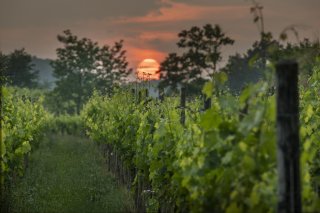
A Sangiovese-led red from Basilicata, aged in cellars cut into sandstone. Grottino di Roccanova became a DOC in 2009. Its zone covers three towns in southern Basilicata: Roccanova, Sant'Arcangelo and Castronuovo di Sant'Andrea. Sangiovese leads the blend. Cabernet Sauvignon, Montepulciano and the local Malvasia Nera di Basilicata fill it out. The wine then matures in grotte, caves dug into soft tuff and sandstone, and some of them go back to the 1700s.
Decode the label
What the label tells you
One word on the front changes the ageing, the strength and the price.
On the label
Grottino Rosso
the cave-cellar red


Sangiovese with Cabernet and Malvasia Nera, aged the old way in the sandstone grottini cut under Roccanova.
No bottles in stock right now
On the label
Rosso Riserva
the deeper shelf of the cave
A degree riper than the base wine, from the parcels the growers trust to wait.
No bottles in stock right now
On the label
Bianco & Rosato
the pale side of the rock
Malvasia Bianca for the white, the red blend pressed pale for the rosato: both drunk within sight of the caves.
No bottles in stock right now
The boundary
Where it is
Everything on this page, the estates, the bottles, the sub-zones, sits inside this line.
The sandstone hills between the Agri and Sinni valleys in southern Basilicata: the communes of Roccanova, Sant'Arcangelo and Castronuovo di Sant'Andrea, in the province of Potenza. The village of Roccanova is honeycombed with the grottini that name the wine, cave cellars dug into the rock where families have kept their barrels for centuries.
Inside the zone
Towns worth knowing
Roccanova's cave quarter is the visit: rows of stone doors in the hillside, each one a family cellar.
In the glass
What it tastes like, by style
One profile at a time, never blended into a single set of bars.

Black cherry


Plum

Liquorice
Almond

Citrusy fruit

Strawberry
Red forest berries
The disciplinare
The rules that define it
The same table on every denomination page, one row group per style here, because Grottino di Roccanova writes its rules per colour.
 SangioveseThe lead, unusually for Basilicata60 to 85%Cabernet SauvignonThe modern reinforcement5 to 30%Malvasia Nera di BasilicataThe perfumed local5 to 30%
 Malvasia Bianca di BasilicataThe leadat least 80%Other local whitesJointly cappedup to 20%
Solid means the rules demand it. Striped means optional, up to that amount. The words on the right say the same rule.

The name means little cave hundreds of sandstone grottini under Roccanova still cellar the village's wine.
Sangiovese leads in Aglianico country the rare Basilicata DOC where the Tuscan grape wears the crown.

8 tonnes per hectare across all colours one of the tightest farming caps in the region.
Riserva means a degree more 13% against the base wine's 12, from the riper parcels.
Three communes on the Agri valley rim Roccanova, Sant'Arcangelo and Castronuovo di Sant'Andrea.
Ageing and alcohol minimums per tier are in the label guide above.
Vintage provenance
Why there is no vintage chart
No denomination-wide vintage chart is currently published for this appellation. Recognised only in 2009, Grottino di Roccanova has too few producers and too small a footprint for the consorzio-style annata ratings used in larger Italian DOPs; quality is tracked producer by producer rather than through a maintained vintage table.
Made in small lots for local tables: buy the newest Rosso and let a Riserva sit three or four years.
What to check instead
The producer: quality here is tracked estate by estate rather than year by year.
How Grottino di Roccanova is made
The rules allow four styles: Rosso, Rosso Riserva, Bianco and Rosato. The reds are led by Sangiovese, at 60 to 85%. Cabernet Sauvignon, Montepulciano and Malvasia Nera di Basilicata each take 5 to 30%. Up to 10% may be other black grapes from Basilicata, as long as they are not aromatic. The Rosato follows the same blend as the red. The Bianco is different, and it rests on at least 80% Malvasia Bianca di Basilicata. Rosso must reach 12% alcohol, and Riserva must reach 13%. Yields are capped at 8 tonnes per hectare, or 8 tonnes for every 2.47 acres. Each hectare must also hold at least 3,300 vines. The ageing clock starts on 1 November of the harvest year. Bianco and Rosato rest 5 months, Rosso 9 months, and Riserva 36 months. Part of the Riserva's time has to pass inside the caves.
In depth
On the table
What to eat with Grottino di Roccanova
The home country leads; global pairings that genuinely work follow.


In-depth guide
Grottino di Roccanova, answered
The Rosso, Rosato and Riserva are led by Sangiovese, at 60 to 85%. Cabernet Sauvignon, Montepulciano and the local Malvasia Nera di Basilicata each add 5 to 30%. Up to 10% may be other black grapes from Basilicata, as long as they are not aromatic. The Bianco is built on Malvasia Bianca di Basilicata, at 80% or more.
Riserva must rest at least 36 months, counted from 1 November of the harvest year. Some of that time has to pass inside the sandstone caves that give the wine its name. Riserva must also reach 13% alcohol, against 12% for the standard Rosso.
In three towns in the province of Potenza, in southern Basilicata: Roccanova, Sant'Arcangelo and Castronuovo di Sant'Andrea. The DOC was approved by ministerial decree on 24 July 2009.
Roccanova sits on the tempe arenarie, slopes of soft sandstone. Growers have cut tunnels into them since at least the 1700s. Inside these grotte the temperature and the humidity stay steady. That protects the wine through southern Italy's hot summers, so there is no need for the mechanical refrigeration that growers further north rely on.
It is lighter in structure than Aglianico del Vulture, the best-known DOC in the region. Grottino is led by Sangiovese, while Aglianico del Vulture is based on Aglianico. Expect brighter cherry here, with violets from Malvasia Nera. Aglianico del Vulture pushes deeper notes of iron and tar.
Yes. The three towns together make only a few hundred hectolitres. That keeps Grottino off most shelves abroad. It stays inside the region's own restaurants and wine shops.
Explore more Basilicata
Same region only: the denominations Grottino di Roccanova drinkers reach for next.


