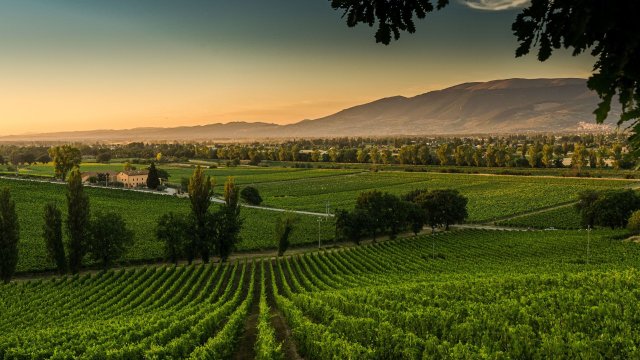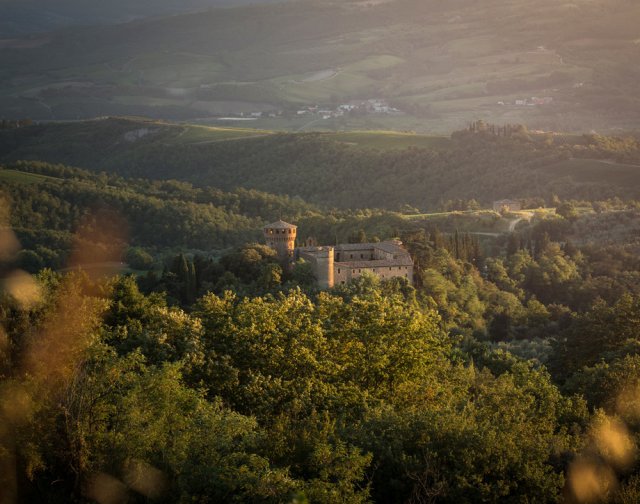


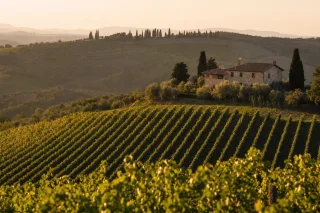
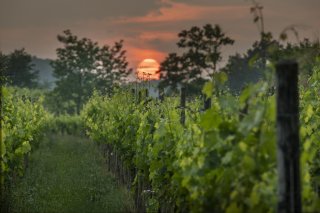
Vittorio Barberani planted the first family vines in 1961 along the road from Orvieto to Todi, on calcareous and clay soils of marine and volcanic origin that slope down to Lake Corbara. This stretch of hills is the oldest part of the Orvieto Classico zone, the historical heart of one of Italy's longest white-wine traditions. His son Luigi and Giovanna extended the holdings with the Monticelli property, and their sons Niccolo and Bernardo run the estate today.
Of the more than 100 hectares the family owns, 55 are planted to vine, and roughly 30 are kept as woodland that sequesters an estimated 240 tonnes of carbon a year. Vineyard work is done by hand, harvest included, and conversion to organic farming was completed in the 1980s, well before it became commercially common in Italian wine. Cover crops and green manure feed the soil between rows, and the cellar relies on physical interventions through vinification rather than chemical corrections.
The whites lean on Grechetto, the principal grape of Orvieto Classico, supported by Procanico, Verdello, and Drupeggio in the traditional blend the denomination requires. Castagnolo is the entry-level Orvieto Classico Superiore; Luigi e Giovanna is a cellar selection from older parcels. The autumn fogs that rise off Lake Corbara create the humid conditions in which Botrytis cinerea concentrates the Grechetto grapes for Calcaia, Barberani's noble-rot wine. On the red side, Polvento blends Sangiovese with Cabernet Sauvignon and Merlot, while a Moscato Passito closes the range as a dessert wine. Annual production sits at around 250,000 bottles, with consultant oenologist Maurizio Castelli guiding the cellar.
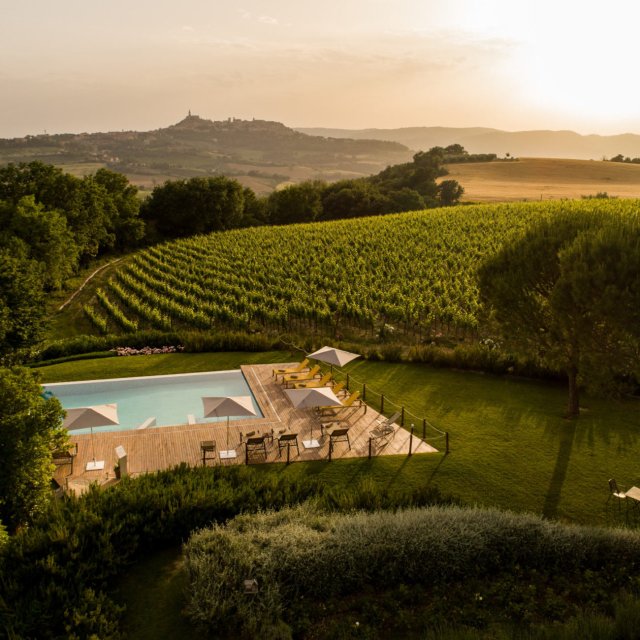
Visits at the Baschi cellar happen by appointment, generally Monday to Friday, with tastings of the white range and the Polvento red overlooking the vineyards and the lake. A separate Enoteca Barberani in Orvieto town, on Via Lorenzo Maitani next to the Duomo, opens daily for retail tastings and bottle purchases.