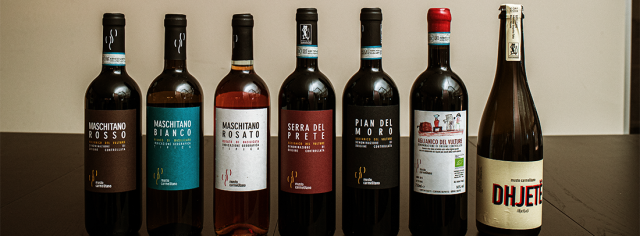
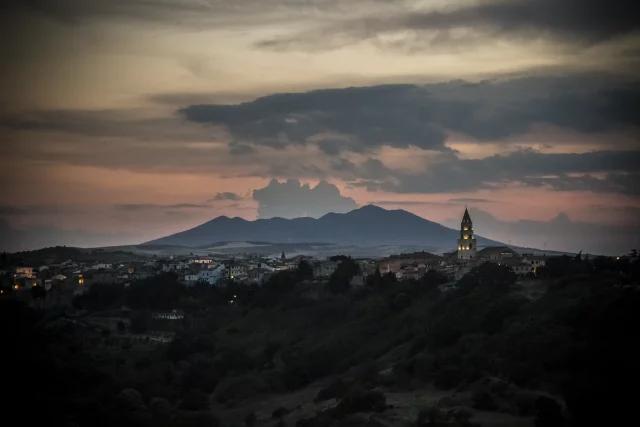
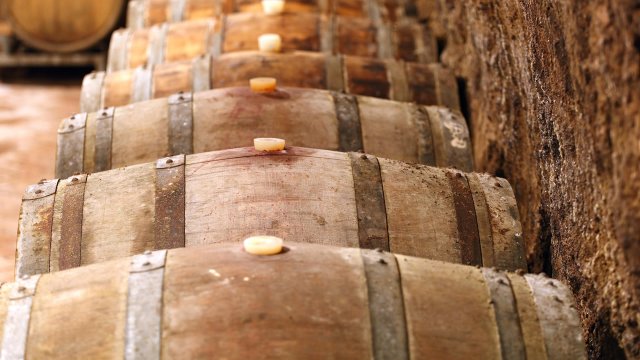
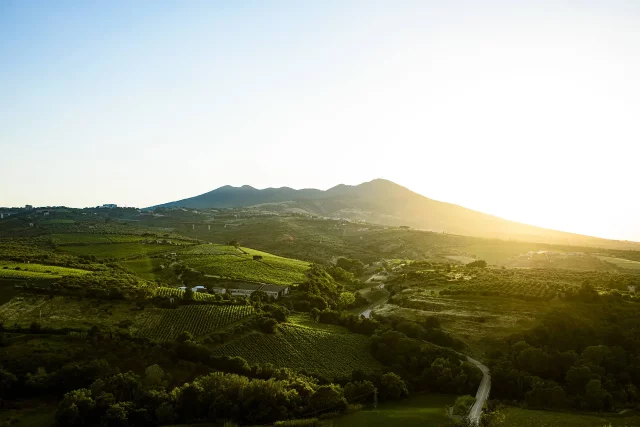
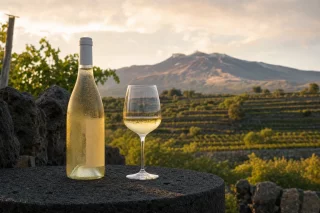
The first bottle bearing the Paternoster name was filled in 1925, when Anselmo Paternoster, a vintner from Barile, started selling his Aglianico in glass instead of demijohn. His son Giuseppe, known as Pino, took over in 1945 and became the first trained enologist of the Vulture, championing the area's volcanic reds across Italy and abroad. In 1971 Pino was among the producers who pushed Aglianico del Vulture to DOC status, anchoring the modern identity of southern Italy's most age-worthy red. The estate spans roughly twenty hectares between 450 and 643 metres of altitude, scattered across the historic Barile contrade of Rotondo, Macarico, Pian di Carro and Gelosia. The soils are a layer cake of pyroclastic tuff laid down by the Vulture eruptions roughly 130,000 years ago. That black volcanic substrate behaves like a sponge, holding winter rain and releasing it slowly through the dry summer, while sharp diurnal swings give Aglianico the long, even ripening it needs. In 2000 the family launched Don Anselmo as a single-estate cru in honour of the founder, and the wine quickly became one of the reference Aglianicos in the south, alongside the more accessible Synthesi. The range now also includes Bariliott from younger Aglianico vines, the Vulcanico Falanghina Basilicata IGT for a white from the same volcanic soils, the Assensi sparkling brut, and the Barone Rotondo Aglianico del Vulture Superiore DOCG cru. In 2016 Paternoster joined Tommasi Family Estates, the Veneto-based group behind Tommasi Viticoltori in Valpolicella, which now owns and runs the estate alongside fourth-generation family enologist Fabio Mecca. Each parcel is still vinified separately so that the differences between Rotondo, Macarico and the other Barile crus can be read in the glass. For visitors, Paternoster matters as the historic anchor of Aglianico del Vulture. The wineshop and cellar at Contrada Valle del Titolo are the easiest place in Barile to taste the full range side by side, walk the volcanic vineyards, and understand why Pino Paternoster spent his career arguing that this corner of Basilicata belonged on the same map as Italy's other great red zones.









 Basilicata, Italy


 1 wine
  Tastings
 Tours
Tours
 Accommodation
 Walk-ins welcome